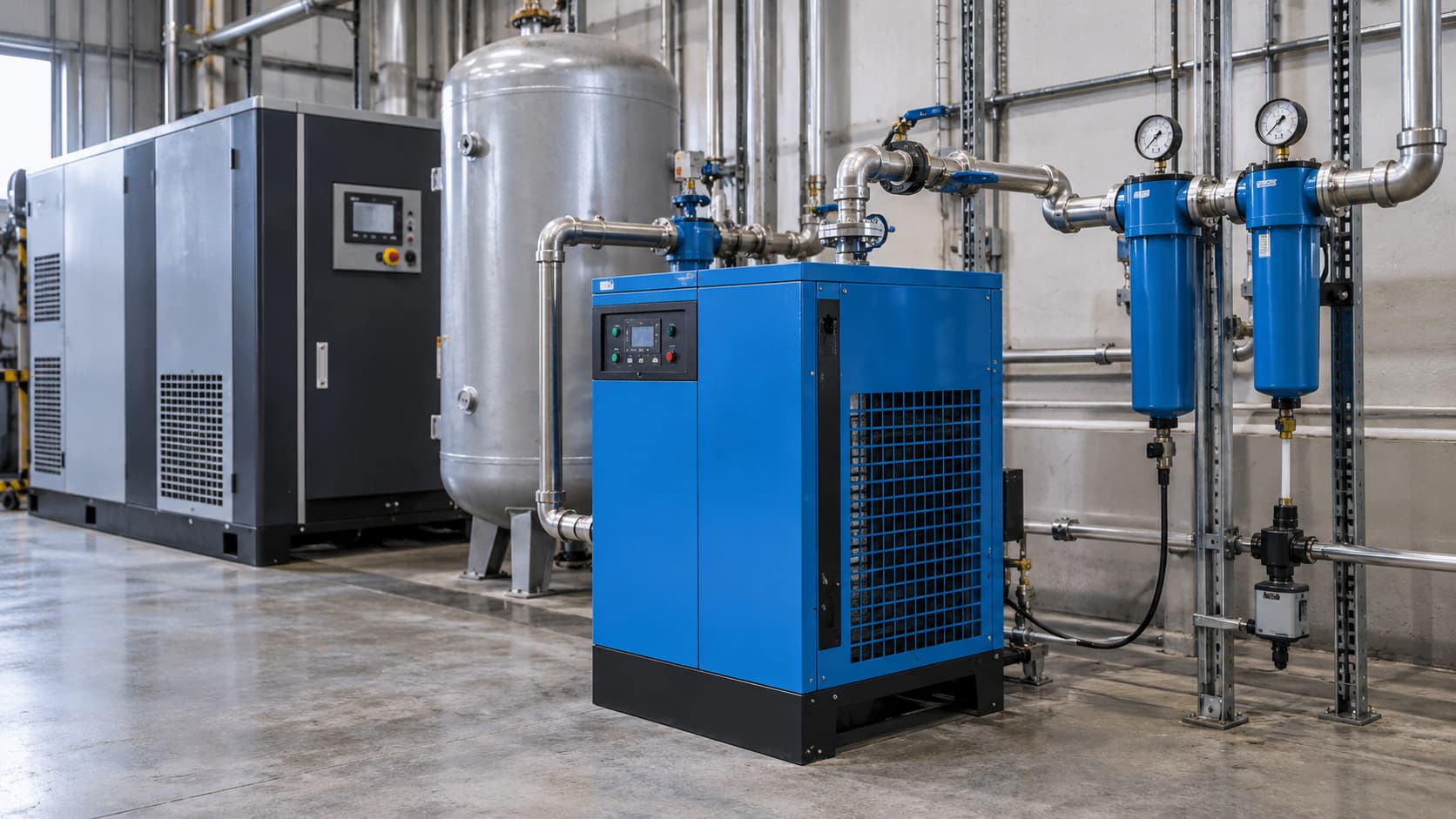
You bought a good air compressor. You sized it correctly. The installation was done by professionals. Yet six months later, your pneumatic tools are rusting, your paint jobs look uneven, and your precision instruments keep failing.
What went wrong?
You skipped the air dryer. Or you installed the wrong type for your climate.
This guide explains why air dryers matter, how they work, which type fits your application, and how to size one correctly so you don't waste money or damage equipment.
Compressed air always contains water
This is the part most compressor brochures leave out. Compressing air concentrates moisture.
Every cubic meter of air your compressor pulls in also contains water vapor. When that air is compressed to 7 bar, about 100 psi, the same amount of moisture gets squeezed into a much smaller volume. The air becomes saturated. As it cools inside your pipes, that moisture turns into liquid water.
In humid regions, such as Mumbai or coastal Gujarat, this isn't an occasional problem. It happens constantly. Water travels through the pipework, collects in low points, and eventually reaches your pneumatic tools, CNC machines, and spray guns.
The hidden damage moisture causes
Water in compressed air rarely causes sudden failure. The damage builds up slowly, which is what makes it dangerous. By the time you notice, the cost is already high.
- Tool wear: Moisture washes away internal lubrication, leading to premature failure of pneumatic tools.
- Rust and corrosion: Metal components that should last for years corrode from the inside.
- Paint defects: Moisture in spray guns causes "fish eyes" and poor paint adhesion, ruining finishes.
- Contamination risk: In pharmaceutical or food packaging plants, moisture can support bacterial growth, putting entire production batches at risk.
- Weld quality: Even in fabrication shops, water spots on metal before welding cause porosity and weak joints.
None of this shows up on day one. It shows up in your maintenance budget six months to a year later.
Types of air dryers explained simply
There are three main types of air dryers. Choosing the wrong one is an expensive mistake, so it helps to understand what each one actually does.
1. Refrigerated Air Dryers
These are the most common type and work much like a refrigerator. They cool compressed air down to around 3 to 5 degrees Celsius, which forces moisture to condense so it can be drained away.
- Dew point achieved: Around 3 to 5 degrees Celsius
- Best for: General manufacturing, workshops, and standard pneumatic tools
- Pros: Affordable to buy and cheap to run
- Cons: Performance drops in ambient temperatures above 40 degrees Celsius, and they cannot produce very dry air
2. Desiccant Air Dryers
These use desiccant beads, similar to industrial strength silica gel, that physically absorb moisture from the air.
- Dew point achieved: As low as -40 degrees Celsius, sometimes -70 degrees Celsius
- Best for: Electronics manufacturing, pharmaceuticals, and instrument grade air
- Pros: Extremely dry, reliable air output
- Cons: Higher purchase cost, and some compressed air is consumed during the regeneration process, which is the drying out of the desiccant beads
3. Membrane Dryers
A newer technology that uses a special membrane to let water vapor pass through while keeping air molecules inside the system.
- Best for: Point of use protection, such as a single CNC machine
- Pros: No moving parts, very reliable, low maintenance
- Cons: Limited flow capacity, not suitable for whole factory systems
Sizing your air dryer correctly
This is where many factories get it wrong.
A common mistake is buying a dryer rated for the compressor's maximum flow, for example 500 CFM, without accounting for inlet temperature and ambient conditions. If your compressor room reaches 45 degrees Celsius in summer, a refrigerated dryer may fail to reach its rated dew point, even though it's technically sized correctly on paper.
Pressure drop is another overlooked factor. A poorly sized or clogged dryer can cost you 1 to 2 bar of pressure, forcing your compressor to work harder and consume more electricity to compensate.
Rule of thumb: Size your dryer for your actual climate and operating conditions, not just the flow rate printed in the brochure.
How to integrate an air dryer into your system
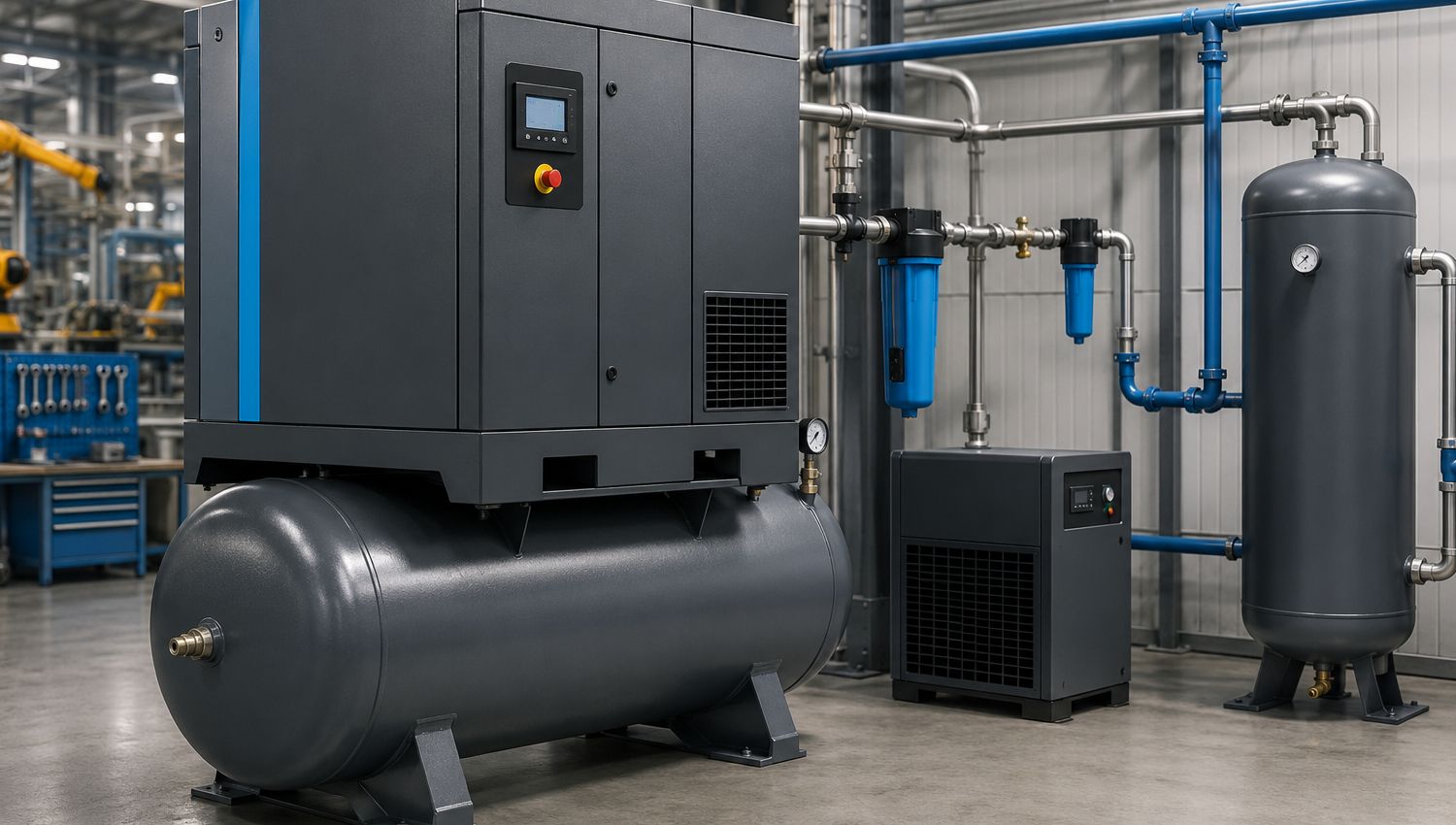
An air dryer should never be an afterthought bolted onto an existing setup. For best results:
- Install a moisture separator before the dryer.
- Position the dryer immediately after the compressor.
- Ensure proper drainage is built into the system.
- Add a bypass line with valves so the dryer can be serviced without shutting down the entire factory.
Final Thoughts
Running a compressed air system in India without proper drying is a gamble. The cost of a quality air dryer is almost always lower than the cost of replacing a ruined pneumatic cylinder or scrapping a batch of rejected products.
To get it right:
- Match the dryer type to your application, whether refrigerated, desiccant, or membrane.
- Size it for your real climate conditions, not just the spec sheet.
- Maintain your drain valves regularly.
Do this, and your tools, your equipment, and your maintenance budget will last much longer.