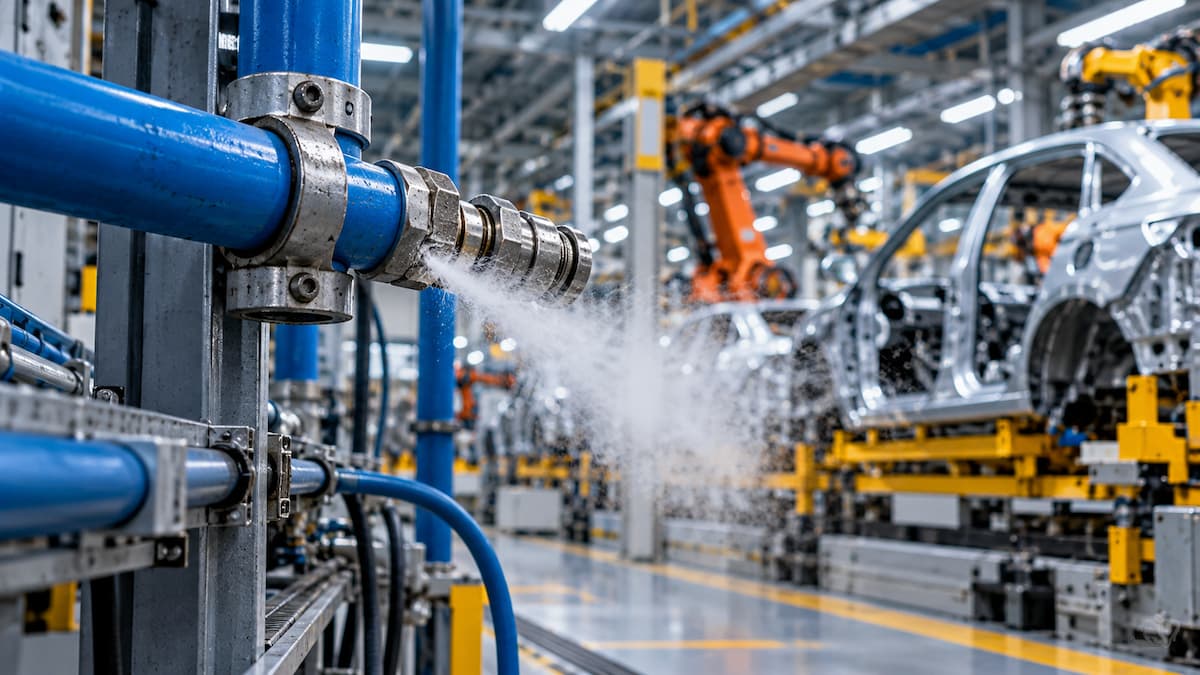
Walk through any automotive plant on a quiet shift and you can hear it: a faint hiss from a fitting, a coupler, a hose clamp. Each one sounds like nothing. Together, they can swallow a fifth or more of everything your compressors produce.
Automotive plants are especially exposed. Assembly lines, robotic cells, paint shops and tool stations all rely on compressed air, and the network behind them is large, with thousands of joints, hoses and quick couplers.
What One Leak Costs
Take a single 3 mm hole in a line running at 7 bar. It wastes roughly 11 litres of air every second. Producing that air takes in the region of 4 kW of compressor power. Over a year of continuous running, that one small hole can cost something like ₹2.5 to 3 lakh in electricity at typical industrial tariffs. Multiply that by the number of leaks in a plant and the total becomes serious.
These are indicative numbers. Your own cost depends on your tariff, operating hours and compressor efficiency, but the pattern holds: small holes, large bills.
Why Leaks Get Ignored
Leaks do not stop production, so nobody sees an urgent reason to fix them. They also do not show up on a single invoice. They just make the compressors work harder, run longer and wear faster. Many plants end up buying an extra compressor to meet demand that a leak audit would have removed.
How to Find Them
Listening and soapy water. These work for a quick check but are slow, and useless in a noisy factory.
Ultrasonic leak detectors. This is the method to use. Escaping air produces high frequency sound that a detector picks up even over machinery noise. The operator walks the line, points the device and finds the source, often from several metres away.
Off-shift pressure decay test. When production is stopped, note how fast system pressure falls, or how often the compressor loads. This gives you an estimate of total leakage as a percentage of capacity.
Where Leaks Usually Hide
- Quick couplers and worn hose ends
- Threaded joints and unions
- Condensate drain valves stuck open
- FRL units and regulators at machine stations
- Old flexible hoses with cracks near the crimp
Making the Fix Stick
Finding leaks once is not enough. They return. Good practice is to:
- Tag every leak found with a numbered tag and log it.
- Repair and record the date and fix.
- Re-audit every quarter or half year.
- Track compressor power or loaded hours against production so you see the benefit.
Good plants aim for leakage below 10% of total air produced. Many older plants run well above 25%.