Walk into a weaving shed and you will hear two things: the looms and the air. Air-jet looms, autoconers, splicers, suction systems and cleaning blowers all run on compressed air, and in many mills the compressor room is one of the biggest lines on the electricity bill.
The trouble is that compressed air is rarely managed like the expensive utility it is. Compressors get bought, installed and left to run. Pressure gets set once, years ago, and never questioned. Leaks are accepted as part of life in the shed. Textile mills also have a few conditions of their own, such as lint, heat and a huge number of pneumatic connection points, that quietly push the bill higher than it needs to be.
The good news is that most of the savings come from running the system better, not from buying new machines. This guide walks through where textile mills lose energy, how to measure it, and the fixes that usually pay back fastest.
Where compressed air is used in a textile mill
Before you can cut the cost, it helps to know what the air is actually doing. In a typical integrated mill, the main uses are:
- Weaving: Air-jet looms use compressed air to carry the weft yarn across the shed. The main nozzle and relay nozzles fire in rapid pulses on every pick, so a weaving shed with a large number of looms can be a very heavy consumer.
- Spinning: Autoconers and winding machines use air for splicing and for suction. Ring frames and compact spinning systems use suction and pneumatic controls. Some blowroom and carding sections use air for transport and cleaning.
- Knitting, processing and finishing: Pneumatic valves, actuators, cylinders and control systems on dyeing, stenter and finishing lines all depend on air, and so do cutting and sewing machines in garment units.
- Cleaning: Blow guns and travelling cleaners remove lint from machines. This is a legitimate use, but also one of the most wasteful if left uncontrolled.
- General utility: Tools, packing equipment and instrument air.
Each of these has a different need for pressure, volume and air quality. That matters, because treating all of them as one block is where a lot of waste begins.
Why compressed air is such an expensive utility
Compressed air is convenient and safe, but it is costly to make. Most of the electricity a compressor uses ends up as heat, and only a small part of the energy ends up as useful work at the end of a pneumatic tool. This is why industry guidance often calls compressed air one of the most expensive forms of energy in a factory.
Over the life of a compressor, the purchase price is usually a small slice of the total cost. Electricity is the large majority. For a machine running two or three shifts, which is normal in a textile mill, the energy bill can pass the purchase price in the first year or two. That is why even a few percentage points of improvement turns into serious money.
Eight reasons textile mills overspend on compressed air
1. Lint and dust in the compressor room
Fine fibre travels everywhere in a textile mill. It clogs intake filters, coats the coolers and settles on the compressor itself. A choked intake filter makes the machine work harder to draw in the same amount of air. A cooler caked in lint cannot shed heat properly, so the air and oil run hotter, which increases the load and can trigger high temperature trips at the worst time.
2. Pressure set for the hungriest machine
Air-jet looms need good pressure to insert the weft reliably, but that does not mean every machine in the mill needs the same. When the whole plant runs at the pressure demanded by the most demanding section, everything else gets more pressure than it needs. A common rule of thumb is that every additional bar of pressure costs roughly 7% more energy, and higher pressure also increases the amount of air lost through every leak. The exact figure depends on your system, but the direction is always the same: higher pressure, higher bill.
3. Hot intake air
Compressor rooms near the shed get very warm in an Indian summer, and a room with poor ventilation can become a heat trap. Warm air is less dense, so the compressor has to work harder to deliver the same mass of air. As a rough guide, every 3 to 4°C rise in intake air temperature costs about 1% in efficiency. A room that runs 15°C hotter than the outside air can therefore be wasting several percent, all year round.
4. Leaks across hundreds of drops
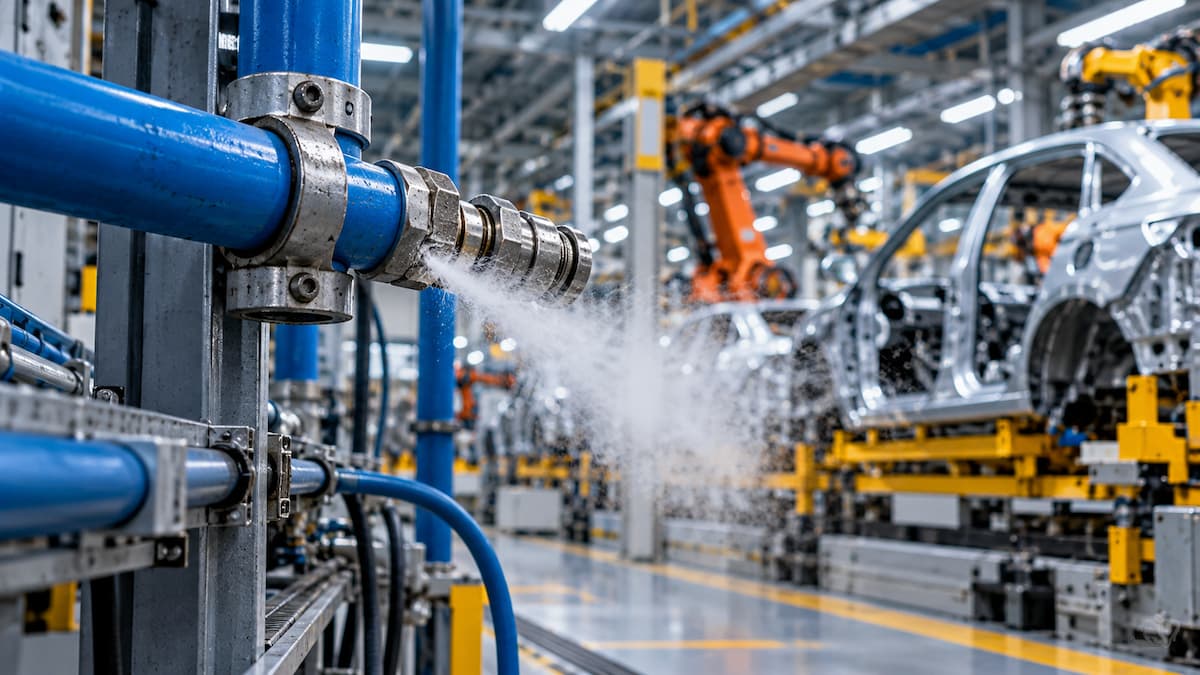
A weaving shed has a very large number of hoses, couplers, regulators and solenoid valves. Each one is a possible leak. A single 3 mm hole in a line at 7 bar can waste around 11 litres of air every second, which takes in the region of 4 kW of compressor power to produce. Across a mill with hundreds of drops, leakage commonly adds up to a quarter or more of total air production in plants that have never done a survey.
5. Compressors running part-loaded
Where several compressors share the job without proper control, it is common to find two or three machines running at low load at the same time. Each one draws a large share of its full power while delivering only a fraction of its air. Running one machine fully loaded and switching the others off would use less electricity for the same output.
6. Wet air and failed drains
Humid conditions, especially in coastal regions, put a lot of moisture into the air before it is compressed. If dryers are undersized or drains are blocked, water travels down the line. It corrodes pipes, damages valves and cylinders, and makes pneumatic controls unreliable. Maintenance teams then compensate by raising pressure or replacing parts more often, which adds cost.
7. Old and undersized piping
Mills grow in stages, and the pipe network usually grows with them, one extension at a time. Long single branches, dead ends, rusted galvanised pipe and too many fittings create pressure drop between the compressor and the loom. Operators fix a pressure problem at the loom by raising the setpoint at the compressor, which costs energy across the whole plant to solve a local fault.
8. Compressed air used where it should not be
Blowing lint off clothing or machines with an open air hose, running open-ended lines, or using compressed air for jobs that a small fan or blower could do are all costly habits. An open air line can consume as much air as a large leak, but unlike a leak it is there on purpose.
Measure first: know your cost per unit of air
Before changing anything, find out what you spend today. Without a baseline you cannot tell which fixes work.
The key number is specific power: the electrical power your compressors draw for each unit of air they deliver, usually shown as kW per m³/min, or as kWh per 1000 m³ of air. It tells you how efficiently you make air. Track it before and after every change.
A proper measurement exercise has these parts:
- Log electrical power on each compressor over at least a week, covering all shifts and a weekend.
- Measure airflow at the compressor outlet or main header, if a flow meter is not already fitted.
- Record pressure at the compressors, at the start of each main branch and at the furthest looms.
- Log running hours and load hours from the compressor controllers.
- Check demand patterns against production: night shift, tea breaks, loom stops and changeovers.
- Calculate the annual cost using your actual power tariff.
This kind of data usually reveals surprises. Plants often discover that off-shift air use is far higher than expected, which points to leaks, or that two compressors are sharing a load that one could carry.
The fixes that bring the bill down
Keep intakes and coolers clean
In a lint-heavy mill, the standard service interval is often too slow. Check intake filters weekly, and clean or replace them based on differential pressure rather than the calendar. Blow out the coolers regularly, and wash them with the right method for the machine. Where lint keeps reaching the compressor, fit a pre-filter or move the intake to a cleaner area. Keep the compressor room itself clean and swept so that lint does not circulate back into the machine.
Bring in cooler air
Duct the intake to a shaded, outdoor location away from the hot exhaust of the machines and away from sources of dust. Make sure the compressor room has enough ventilation to carry away the heat the machines release, with the hot exhaust air ducted out rather than recirculating. In many mills, fixing ventilation is among the cheapest improvements available.
Lower the pressure to what the process needs
Measure the pressure at the looms during peak production, not at the compressor. Then reduce the compressor setpoint in small steps, while watching loom performance and weft insertion. The reduction in energy can be significant: even a drop of 0.5 bar can trim a few percent off the compressor power. If one section really needs a higher pressure than the rest, consider feeding it separately through a dedicated line or a small booster, instead of raising pressure for the entire mill.
Run a leak survey, and repeat it
Use an ultrasonic leak detector, which can pick out leaks even in a noisy shed. Tag each leak with a numbered label, log it, repair it and record the date. Common culprits include quick couplers, worn hose ends, threaded joints, stuck-open drain valves and regulators at machine stations. A good target is to bring leakage under 10% of total air production. Repeat the survey every quarter or half year, because leaks return.
Sequence the compressors properly
When several compressors share the load, a central controller decides which machines run and which stay off, based on demand. It keeps the group working at efficient points and prevents multiple machines from running part-loaded at once. Atlas Copco's Optimizer 4.0 is an example of this type of controller. It can also hold system pressure in a narrower band, which allows a lower setpoint.
Use a VSD compressor as the trim machine
Textile demand rises and falls with loom speeds, stoppages and shifts. A variable speed drive (VSD) compressor changes its motor speed to follow demand, so it does not waste power running unloaded. A common arrangement is to let fixed speed machines carry the steady base load at full output, and use a single VSD unit for the part of demand that moves. Savings depend on your demand profile, so ask for a calculation based on your own logged data rather than a catalogue percentage.
Fix the distribution network
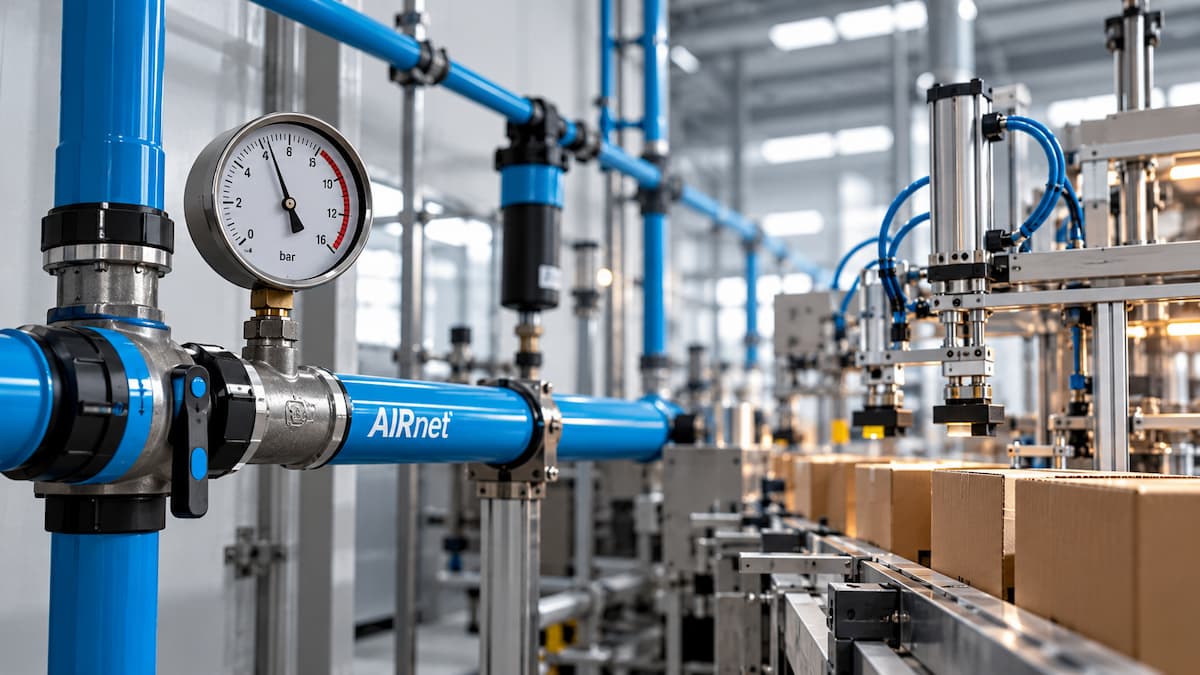
If pressure at the far end of the shed is much lower than at the compressor, look at the pipe. Replace long single branches with a ring main, remove dead ends and unnecessary fittings, and shorten flexible hose runs. Where old galvanised pipe has rusted, consider a smooth bore, corrosion-free system such as AIRnet aluminium piping, which holds pressure and keeps scale out of the air.
Treat the air properly
Make sure your dryer is sized for the actual flow and the ambient conditions, and that drains are working. Replace filter elements on schedule, because a clogged element adds pressure drop and power cost. Dry, clean air protects valves, nozzles and cylinders, and stops the pressure being raised to cover for failing equipment.
Stop the wasteful uses
Replace open blow guns with low-flow nozzles or, where possible, with small fans or blowers. Fit isolation valves so that sections of the mill that are not running, such as an idle weaving block, can be cut off from the network instead of leaking air all night. Close or cap open-ended lines.
Recover the heat
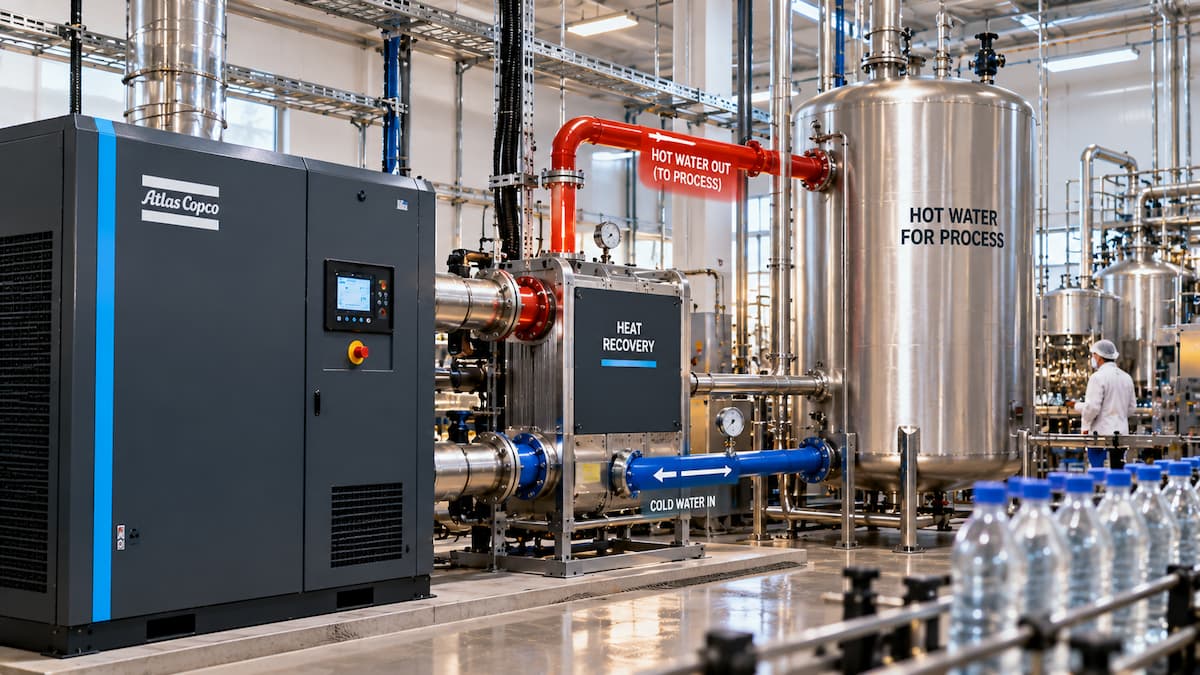
Nearly all the electrical energy that goes into a compressor ends up as heat. In a water cooled machine, a large share of that can be captured as hot water. Textile processing, dyeing, washing and finishing all need hot water, so a mill with a process house close to the compressor room is a good candidate. Even in an air cooled machine, the warm exhaust air can sometimes be ducted to a space that needs heating or drying. Check the recoverable amount and temperature for your specific model with the manufacturer.
An illustrative example
The numbers below are only an example to show how the savings add up. Your own figures will differ.
Suppose a mill's compressors draw an average of 200 kW and run about 7,000 hours a year. At a tariff of ₹8 per kWh, the yearly electricity cost is about ₹1.12 crore (200 kW × 7,000 hours × ₹8).
- Cutting leakage and lowering pressure together might save 8 to 10% of that.
- Fixing intake temperature, cleaning coolers and better sequencing might save another 3 to 5%.
- Adding a VSD trim machine could add more, depending on the load profile.
Even a 15% total saving on this example would be roughly ₹16.8 lakh a year. That is the reason an energy audit is worth doing before any equipment purchase.
A simple maintenance routine
Daily: check compressor pressure, temperature and any alarms. Check that drains are discharging. Look at the intake filter indicator.
Weekly: inspect and clean intake filters and cooler surfaces in lint-heavy areas. Check the differential pressure on filters. Walk the shed and listen for obvious leaks.
Monthly: record specific power and compare it with the previous month. Review the leak log. Check dryer dew point readings.
Quarterly or half-yearly: run a full leak survey with an ultrasonic detector. Review pressure at the furthest looms. Check the compressor room temperature and ventilation.
As per running hours: follow the manufacturer's schedule for oil, separator, filter and belt changes, using genuine parts.
Mistakes to avoid
- Raising pressure to fix a local problem. Find the cause first, whether it is a clogged filter, a leak or an undersized pipe.
- Buying another compressor to meet demand. Often a leak survey recovers the capacity you thought you were missing.
- Setting pressure once and forgetting it. Demand changes as looms are added or removed, so review the setpoint regularly.
- Treating filters as optional. Skipped changes cost more in electricity than the filter does.
- Ignoring the compressor room. Heat, dust and poor ventilation undo much of the efficiency you pay for.
A 90-day plan to get started
- Days 1 to 15: install logging, measure power, flow and pressure, and calculate your specific power and annual air cost.
- Days 15 to 30: clean intakes and coolers, fix ventilation, and run the first ultrasonic leak survey.
- Days 30 to 60: repair the leaks, tag and log them, and lower the pressure setpoint in small steps while watching loom performance.
- Days 60 to 90: review sequencing and controls, decide whether a VSD trim machine or central controller is justified, and check whether heat recovery suits your hot water demand.
- Ongoing: track specific power monthly and repeat the leak survey every quarter.
Frequently asked questions
How much can a textile mill save on compressed air?
It depends on how well the system is run today. Mills that have never audited their air often find savings of 15 to 30% of their compressed air electricity, but the real number can only come from measurement. Treat any figure that is not based on your own logged data with caution.
Is it better to buy a new compressor or fix the existing system?
Fix the system first. If you buy a new machine before dealing with leaks, pressure and poor distribution, you end up paying to produce air that is then wasted. Once the system is tuned, you will know exactly how much capacity you really need.
How often should intake filters be cleaned in a spinning or weaving mill?
More often than the standard schedule suggests. In lint-heavy areas, a weekly check is sensible, and replacement should follow differential pressure readings rather than a fixed date.
Do air-jet looms really need high pressure?
They need enough pressure to insert the weft reliably, which depends on the fabric, yarn and loom setting. Many mills run higher than needed out of habit. Reduce in small steps while monitoring loom efficiency to find the lowest pressure that keeps performance steady.
Can compressor heat really be used in a textile mill?
Yes, where there is a steady hot water need nearby. Processing, dyeing, washing and finishing units are the best fit. The recoverable heat depends on the compressor type and the recovery system, so confirm the figures with the manufacturer.
Where to begin
Compressed air does not have to be a black box on your electricity bill. A week of proper measurement, a leak survey, cleaner intakes and a sensible pressure setpoint will usually show you where the money is going, and often pay for themselves quickly.
Airkom Agencies is an authorised Atlas Copco distributor in Mumbai with more than 35 years of experience in compressed air. We offer compressed air energy audits with flow and power measurement, leak surveys and a clear list of savings, along with genuine parts, service plans and the full range of compressors, dryers, filters and AIRnet piping. If your mill has never measured its compressed air cost per unit, that is the place to begin. Talk to our team about an energy audit.