It is one of the most common questions a plant manager asks before buying a compressor: should it be variable speed (VSD) or fixed speed? Suppliers often say that VSD saves energy, and in many plants that is true. But it is not true in every plant, and paying extra for a VSD that never gets to use its advantage is money wasted.
The right answer depends on one thing more than any other: how much your air demand changes through the day, the week and the year. This guide explains how both types work, where each one wins, how to read your own demand pattern, and how to make a decision you can defend with numbers.
The short answer
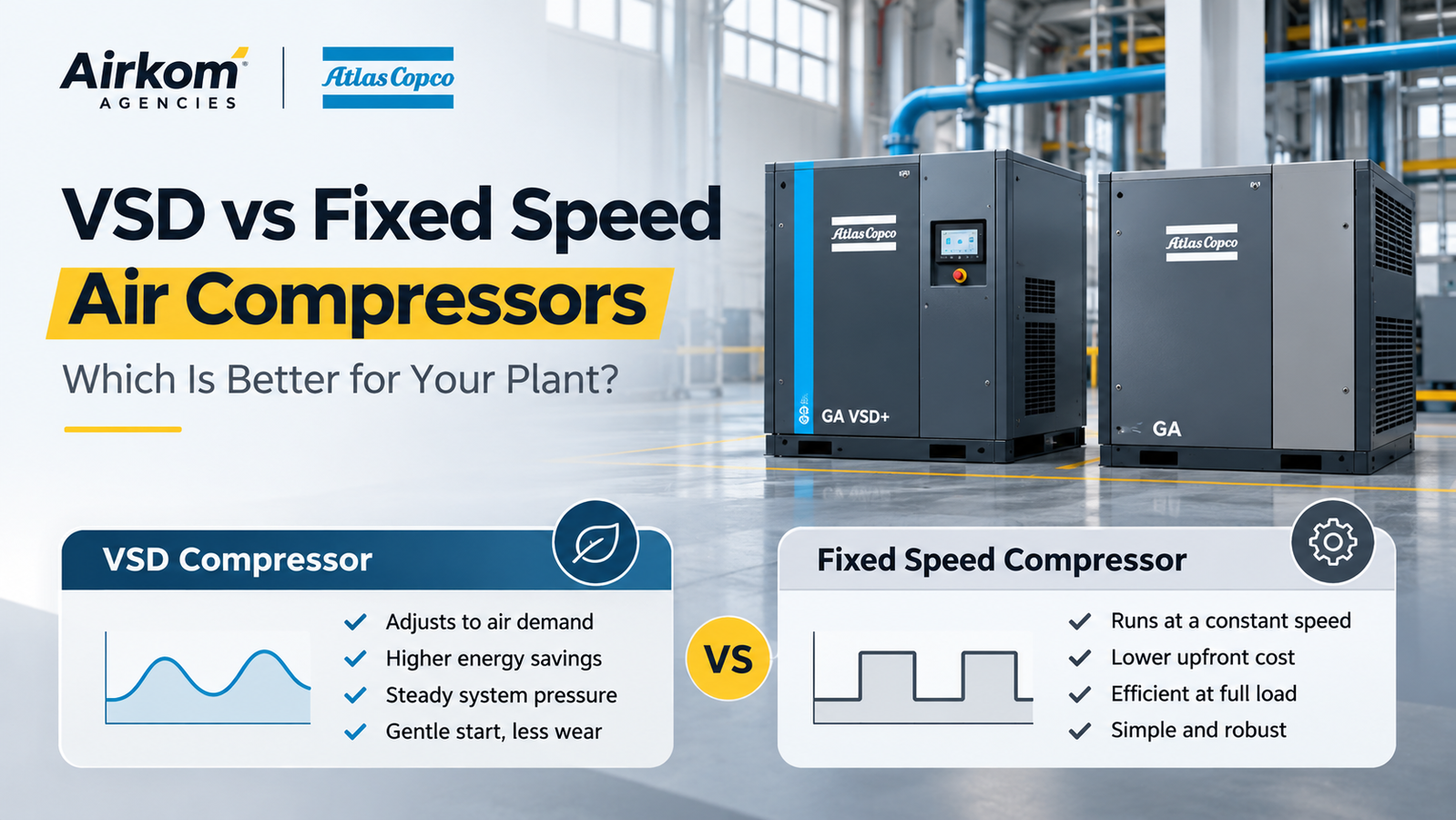
If your plant uses close to the full output of a compressor for most of its running hours, a fixed speed machine is usually the better buy. If demand swings widely, with long periods well below the compressor's capacity, a VSD machine usually saves enough electricity to repay its extra cost. If you have several compressors in one room, the best result often comes from combining the two: fixed speed units on the steady base load and one VSD unit following the changing part of demand.
The rest of this article shows you how to confirm which case applies to you.
How a fixed speed compressor works
A fixed speed rotary screw compressor runs its motor at one speed whenever it is switched on. It produces its full rated output whenever it is loaded. Because your plant rarely uses exactly that amount of air, the compressor needs a way to cope with the difference. It does this in one of two ways.
Load and unload control. When system pressure reaches the upper limit, the compressor unloads. It stops compressing air, but the motor keeps spinning. As pressure drops to the lower limit, the compressor loads again. The air receiver and piping act as a buffer between those two points.
Modulation control. Some machines throttle the intake to reduce output. This avoids repeated load and unload cycles, but it is generally less efficient at part load, and it is used less often on modern industrial screw machines.
The key point is what happens during the unloaded period. A fixed speed rotary screw compressor does not draw zero power when it is unloaded. It typically still draws a significant share of its full load power, often in the range of 20 to 35%, depending on the model. During that time it delivers no air at all. If a machine spends a third of its time unloaded, that is a third of its running hours producing nothing.
How a VSD compressor works
A VSD (variable speed drive) compressor uses a frequency converter to change the speed of its motor. When the plant needs less air, the motor slows down and the compressor delivers less. When demand rises, it speeds up. The compressor follows demand continuously, rather than switching between full output and no output.
This has four practical effects:
- Power follows air. Over most of its working range, the energy drawn falls roughly in line with the air delivered, so there is far less wasted idle running.
- Pressure stays steady. Because output is matched to demand, system pressure can be held within a very narrow band around the setpoint.
- Starting is gentle. The motor ramps up smoothly instead of drawing a large starting current.
- There are fewer load and unload cycles. This reduces wear associated with repeated switching.
A VSD is not magic. The drive itself has small electrical losses, so at full load a VSD machine may use slightly more power than an equivalent fixed speed machine. And a VSD has a minimum speed. Below a certain level of demand, it cannot slow down further and will unload or stop instead. The range between its minimum and maximum flow is called its turndown, and it varies between models, so always check it for the machine you are considering.
Where VSD usually wins
Demand that swings
Single shift plants, batch processes, lines that stop for lunch and changeovers, and factories where machines switch on and off during the day all create swings in demand. Every time air use falls below capacity, a fixed speed compressor wastes energy unloaded, while a VSD slows down. This is the clearest case for VSD.
Tighter pressure control
A fixed speed compressor works within a pressure band between its load and unload points, often half a bar or more wide. To make sure the lowest point in that band is still enough for the plant, operators set the upper limit higher than necessary. A VSD can hold pressure within a much narrower band, which lets you lower the setpoint. Since each extra bar of pressure costs roughly 7% more energy as a common rule of thumb, a narrower band can save energy across the entire system, not just at the compressor.
Limited electrical supply
A direct-on-line or star-delta start draws a high current for a moment. In plants with a weak supply, a generator backup or tight limits from the utility, the smooth start of a VSD is a real advantage.
Fluctuating or growing plants
If you are not sure how much air you will need next year, a VSD offers flexibility. It can follow a demand that rises and falls without you having to guess the exact size beforehand.
Where fixed speed still makes sense
Steady, high demand
If the plant uses nearly all of the compressor's output for most of its running hours, there are few unloaded periods to remove. A fixed speed machine running fully loaded is very efficient, and the VSD's drive losses give it no advantage.
Low running hours
A compressor that runs a few hours a day will take many years to repay the extra cost of a VSD, even if its efficiency is better. The saving is proportional to the running hours, so low hours mean a long payback.
Tight capital budgets
Fixed speed machines cost less to buy. When demand really is flat, or money is tight and the machine is for a secondary role, spending less up front is a legitimate choice.
Harsh electrical or environmental conditions
A VSD adds an electronic drive to the machine. In very hot, dusty rooms, or where the power supply is poor, the drive needs proper cooling and clean air to last. This is manageable, but it needs attention. A simple fixed speed machine has less to go wrong in difficult conditions.
The best answer is often both
Many plants do best with a mix. Consider a room with three compressors. Two fixed speed machines run at full load covering the steady demand that is there all the time. A single VSD machine covers the rest, rising and falling with changes in demand. The fixed speed units spend their hours at their most efficient point, and the VSD handles the part of the demand that a fixed speed machine handles worst.
This approach gives most of the savings of VSD without paying the premium on every machine. It does need sensible control. If several machines try to follow the pressure signal independently, they can end up fighting each other, with one speeding up while another unloads. A central controller that decides which machine runs and when, such as Atlas Copco's Optimizer 4.0, prevents this and keeps the group working at efficient points.
Step one: measure your demand
You cannot choose well without knowing your demand profile. Here is how to get it.
- Log airflow or compressor load for at least one full week, covering all shifts and the weekend. If your business is seasonal, try to capture both busy and quiet periods, or at least ask when they occur.
- Record electrical power at the same time, so you can see how much energy is used at each level of demand.
- Plot the profile. A chart of air demand against time of day shows at a glance how steady or variable it is.
- Note the pressure. Record the pressure at the compressor and at the furthest point of use. The minimum pressure your process actually needs decides how low you can set the compressor.
- Mark the peaks and valleys. What is the lowest steady demand, and how long does it last? What is the highest peak, and how often does it occur?
Reading the profile
- Flat profile, close to compressor capacity: fixed speed is probably enough.
- Flat profile, well below capacity: the compressor is probably oversized. Consider a smaller machine before thinking about VSD.
- Wide swings, with long periods at half capacity or less: VSD is likely to pay back.
- High steady base with a variable top: fixed speed for the base, VSD as the trim machine.
- Large differences between shifts or between weekdays and weekends: VSD, or a multi-compressor room with good sequencing.
An illustrative example
The figures below are invented to show how the logic works. Your numbers will differ, and you should work from your own measurements.
A plant has a 75 kW compressor running 6,000 hours a year. Demand averages around 60% of the compressor's capacity, with significant swings through the day. Logging shows that, over a year, the fixed speed machine averages about 68 kW once its unloaded periods are included. A VSD delivering the same air averages about 54 kW.
- Difference in average power: 14 kW
- Yearly energy saved: 14 kW × 6,000 hours = 84,000 kWh
- At ₹8 per kWh: about ₹6.7 lakh a year
If the VSD costs, say, ₹10 lakh more than the fixed speed machine, the simple payback is about one and a half years. That is a strong case.
Now change one thing. Suppose the same plant's demand were steady at 90% of capacity. The difference in average power between the two machines might shrink to only a few kW, or even reverse, and the payback might stretch beyond the machine's useful life. Same plant, same machine, different demand, opposite answer. That is why the demand profile matters more than any catalogue figure.
Sizing: do not oversize the VSD
A common mistake is choosing a VSD that is too big, on the belief that a VSD can handle anything. A VSD works best when its working range matches your demand. Oversizing pushes your demand into the lower part of its range, where it may reach the minimum speed and start unloading, losing much of the benefit.
When selecting size, consider:
- Peak demand, including a sensible allowance for growth, not a wild guess.
- Minimum steady demand, compared with the machine's minimum flow.
- The air you will recover, after a leak repair programme brings down waste.
- Redundancy, because a single compressor means a stop when it is serviced.
It is wise to fix leaks and reduce the pressure setpoint before sizing, because a plant that cuts its air waste may need a smaller compressor than it thought.
Practical points to check before buying a VSD
- Room temperature and ventilation. Drives dislike heat. Make sure the compressor room can stay within the manufacturer's limits, particularly in summer.
- Dust. In dusty plants, check how the drive cabinet is cooled and filtered, and plan for cleaning.
- Power quality. Voltage fluctuation and harmonics can affect drives. Ask about the supply conditions the machine is designed for.
- Turndown range. Compare your minimum demand against the machine's minimum flow.
- Controls and monitoring. Check that the controller can work with your other compressors, and whether remote monitoring is available.
- Service support. A VSD needs trained service engineers who can handle the drive as well as the compressor. Check the supplier's local service network.
- Efficiency data. Ask for specific power at several load points, not just at full load.
Common mistakes
- Buying a VSD for a flat load. You pay extra for flexibility you never use.
- Not lowering the pressure setpoint. A VSD's tight pressure band is a chance to run at a lower pressure. If the setpoint stays where it was, part of the potential saving is lost.
- Running several VSDs without central control. They can hunt against each other and waste the gain.
- Oversizing. A VSD that is far larger than your demand spends its life near its minimum speed.
- Ignoring the rest of the system. Leaks, clogged filters, poor piping and wet air all waste energy, whichever compressor type you choose. Fix them first or alongside.
- Relying on a catalogue percentage. Savings figures depend on the load pattern assumed. Ask for the calculation based on your own data.
A simple decision checklist
- Log your air demand for at least a week.
- Fix major leaks and set the lowest workable pressure.
- Plot the demand profile against compressor capacity.
- Estimate the yearly energy cost for fixed speed and VSD using your tariff and running hours.
- Subtract to find the yearly saving, then divide the extra purchase cost by that saving to get payback.
- Check the practical points: room, power, service and controls.
- If you have a multi-compressor room, consider fixed speed for base load with one VSD for trim.
Frequently asked questions
Does a VSD compressor always save energy?
No. It saves energy when demand is below the compressor's capacity for a meaningful part of its running time. When demand is close to full capacity all the time, there is little to save, and the drive's small losses can cancel the benefit.
How much can a VSD save?
It depends entirely on the demand profile. Plants with large swings can see substantial savings compared with fixed speed machines, but the real figure can only come from your own measured data. Be cautious about any percentage that is not based on your load pattern.
Can I convert my existing fixed speed compressor to VSD?
In some cases a drive can be added to an existing machine, but it depends on the model and its design. It is usually better to discuss this with the manufacturer or distributor, who can tell you whether a retrofit is suitable and supported.
What about oil-free compressors?
The same logic applies. Oil-free machines are also available with variable speed, and the same demand profile rules decide whether it is worthwhile.
Is a VSD better for the compressor itself?
A VSD avoids repeated load and unload cycles and high starting currents, which can reduce some mechanical and electrical stress. But the machine still needs the same care: clean filters, correct oil, good ventilation and regular service.
Should I buy one big VSD or two smaller machines?
Two smaller machines give you backup during service, and let one run efficiently while the other covers peaks. One large machine is simpler but leaves you without air if it stops. For plants where air supply is critical, two machines is often the safer choice.
Where to begin
The VSD versus fixed speed question is really a question about your plant's demand. A week of logged data turns it from an opinion into a calculation, and often shows that the answer is a mix rather than a choice of one.
Airkom Agencies is an authorised Atlas Copco distributor in Mumbai, with more than 35 years of experience in compressed air. We supply the full range of Atlas Copco compressors, including GA VSD screw compressors, along with dryers, filters and AIRnet piping, and we can log your air demand and tell you which setup suits you before you spend anything. Ask for a compressor demand study.