Buying an industrial air compressor is not like buying a pump or a motor. It is a purchase you live with for 10 to 15 years or more, and the price on the quotation is only a small part of what it will cost you. Electricity, service, spares and downtime decide the real cost. That is why choosing the right dealer in Mumbai matters nearly as much as choosing the right machine.
This guide is for plant owners, purchase managers and maintenance heads who are comparing air compressor dealers and suppliers in Mumbai, Navi Mumbai, Thane and the Gujarat belt. It explains what decides the price of an Atlas Copco screw compressor, how to compare quotations fairly, when renting makes sense, what a good service contract includes, and the questions to ask any dealer before you sign.
Why the dealer matters as much as the machine
Two dealers can quote the same compressor model and still give you very different experiences. The machine is the same, but these things are not:
- Whether the dealer is an authorised partner of the manufacturer, which affects warranty, genuine parts and access to factory-trained engineers
- How quickly engineers reach your plant when something stops
- Whether spares are held nearby or have to be ordered from far away
- Whether the dealer helps you size the system properly or simply sells the model they have in stock
- What happens after commissioning, including training, service plans and support
A compressor is the heart of your plant's air supply. When it stops, production often stops with it. So treat the dealer as a long-term partner, not just a seller.
What decides the price of a screw air compressor
When someone searches for the price of an Atlas Copco air compressor in Mumbai, they usually want a single number. The honest answer is that there is no single number, because the price depends on several choices. Understanding them helps you ask for the right quotation and avoid paying for things you do not need.
1. Size and air delivery
Compressors are sized by the amount of air they deliver, called free air delivery (FAD), measured in cubic metres per minute or cubic feet per minute, and by the working pressure in bar. Motor power in kW or HP gives a rough idea, but it is the FAD at your required pressure that tells you what you are actually buying. A larger machine costs more to buy and more to run, so right-sizing matters. An oversized compressor wastes money twice, once in the purchase price and again in the electricity it burns running part-loaded.
2. Fixed speed or variable speed (VSD)
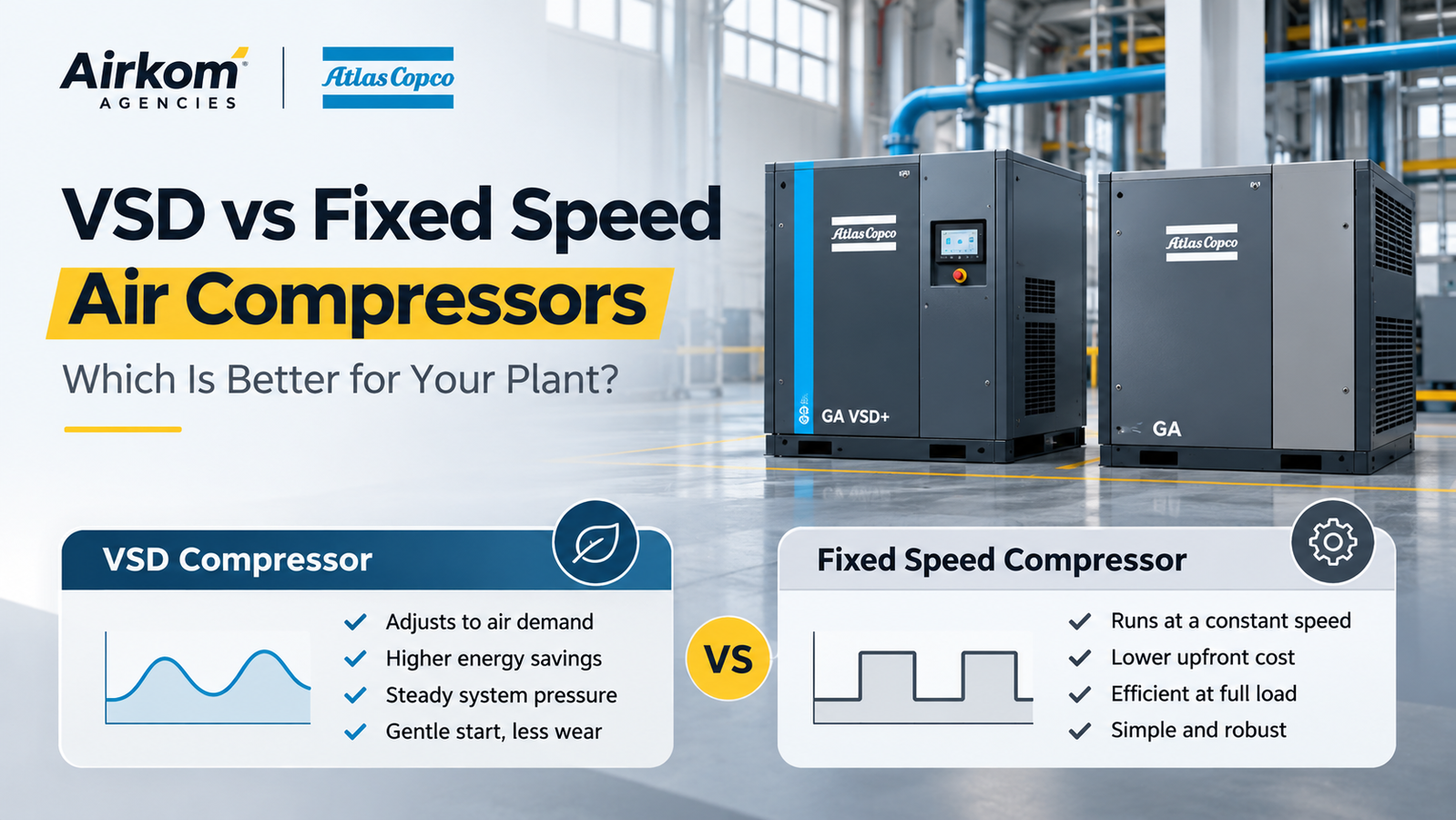
A VSD compressor costs more to buy than a fixed speed one of the same size, but it can use less electricity when your air demand changes through the day. Whether it pays back depends on your demand pattern. If your plant uses a steady amount of air close to the compressor's capacity, fixed speed is often enough. If demand swings, VSD usually repays the extra cost.
3. Oil-injected or oil-free
Oil-injected screw compressors suit most general industrial work. Oil-free compressors are used where oil in the air is unacceptable, such as pharmaceuticals, food and beverage, electronics and some textile and packaging applications. Oil-free machines cost more, because of their design, and need to be matched to the purity class your process requires.
4. Air treatment
Raw compressed air contains water, oil traces and particles. Most plants need at least a dryer and filters, and sometimes an air receiver and condensate management. Cheap quotations sometimes leave these out, which looks attractive until you see the damage that wet, dirty air does downstream. Always check whether the dryer and filters are included, and whether they are sized for your conditions. In humid cities like Mumbai, dryer sizing is especially important.
5. Piping and installation
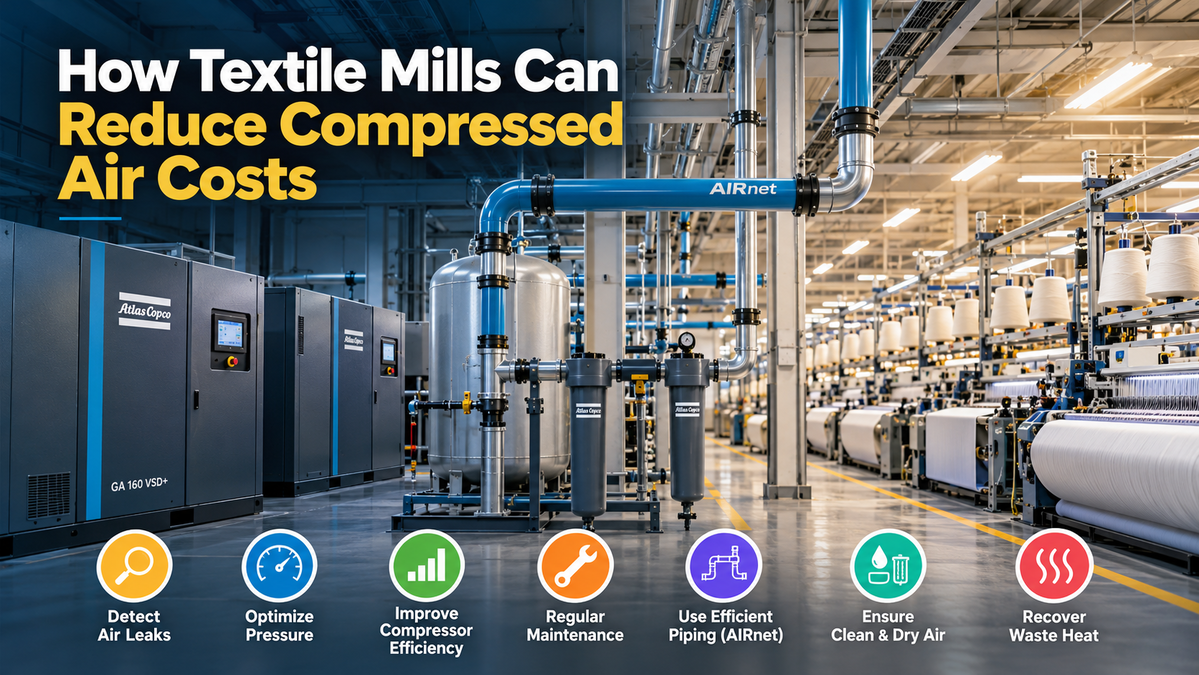
The cost of installation depends on the distance to the points of use, the pipe material and the work involved. A poorly designed pipe network wastes pressure and energy for years. Modern aluminium systems such as AIRnet cost more than basic galvanised pipe at the start, but are cleaner, faster to install and hold pressure better.
6. Controls and monitoring
If you plan to run several compressors, a central controller improves efficiency by sequencing the machines. Remote monitoring options let you track pressure, temperature and service due dates. These add to the price but can reduce running cost and downtime.
7. Warranty, commissioning and service plan
Check what warranty is included, who commissions the machine, whether your operators get training, and what service plan is offered for the first few years. These are real costs that appear on some quotations and not on others.
Look at the total cost, not the purchase price
The purchase price of a compressor is typically a small share of what it costs over its life. Electricity is usually the largest part, often well over half of total ownership cost for a machine that runs long hours. Service, spares and downtime make up much of the rest.
That means a slightly cheaper machine that uses more power can be the more expensive choice within a couple of years. When comparing quotations, ask for:
- Specific power: the electrical power used for each unit of air delivered, usually in kW per m³/min. A lower number means lower electricity cost.
- Performance at your actual operating pressure, not only at the catalogue rating.
- Expected service costs for the first five years.
- Availability and price of genuine spares.
Even a small difference in specific power adds up. A machine that uses a few percent less electricity, running 6,000 hours a year for ten years, can save far more than the price difference between two quotations.
How to compare quotations properly
Quotations from different suppliers often look different because they include different things. To compare fairly, put them side by side and check:
- Same FAD at the same pressure. Make sure each offer is for the same delivered air, measured to the same standard.
- Same scope. Is the dryer included? Filters? Receiver? Piping? Installation? Commissioning?
- Same control type. Fixed speed or VSD, and what controller.
- Same air quality. Does the offer meet the purity your process needs?
- Warranty terms. Duration, what is covered, and whether it depends on using genuine parts and approved service.
- Delivery time and payment terms.
- Service plan and spares. What is offered after the machine is installed?
If any of these are missing from a quotation, ask. A low price with a missing dryer is not low.
Questions to ask any air compressor dealer in Mumbai
- Are you an authorised distributor for this brand, and can you show it?
- How many installations have you done, and can I speak to some customers in my industry?
- Where are your service engineers based, and what is the usual response time to my area?
- Do you stock genuine spares locally, and which ones?
- Will you measure my air demand before recommending a size?
- What happens if my machine stops, do you offer a backup or rental unit?
- What does your service contract include and exclude?
- Do your technicians have factory training on this machine?
A dealer who answers these clearly and without hesitation is usually a good sign. One who avoids them is worth questioning.
Renting an air compressor in Mumbai: when it makes sense
Buying is not always the right answer. Renting an air compressor can be better in several situations:
- Breakdown cover. Your own compressor has failed and repairs will take time. A rental unit keeps production going.
- Planned shutdowns. While your main machine is serviced or overhauled.
- Temporary demand. Seasonal peaks, short projects or trial production runs.
- Testing before you buy. Running a machine on your actual load before committing to a purchase.
- Capital constraints. When you would prefer to spend operating budget than capital.
For continuous, long-term use, buying usually works out cheaper. For short or uncertain needs, renting avoids tying up capital in equipment you may not need for long. Ask about delivery time, running hour limits, who handles servicing during the rental and what is included in the rate.
Annual maintenance contracts (AMC) and service plans
A compressor that is serviced on time lasts longer, uses less energy and fails less often. An AMC or service plan puts that into a schedule, so maintenance does not depend on someone remembering. A good plan should clearly state:
- How many visits per year and at what intervals, usually by running hours
- Which parts and consumables are covered, such as oil, filters and separators, and which are billed separately
- Whether genuine parts are used
- Response time for breakdowns
- Whether the plan covers dryers, filters and other equipment, or only the compressor
- Reporting, so you can see the condition of your machines
Compare plans on what they include, not only on the annual price. A cheap plan that excludes most parts can cost more than a complete one.
Genuine spares versus cheap copies
Air compressor spare parts in Mumbai are available at many price levels. Copies of oil filters, air filters and separator elements can look the same and fit the same housing, but differ in how well they perform. Poor separation lets oil carry over into the air system. A weak filter lets dirt through to the screw element. A wrong oil can damage the machine and may void the warranty.
The saving on a cheap part is small compared with the cost of an element failure or a stop in production. For critical consumables, use genuine parts and keep a small stock of the common ones on the shelf.
Buy, rent or service: a quick guide
| Your situation | Best option |
|---|---|
| New plant or expansion with steady long-term demand | Buy, sized from a demand study |
| Demand varies a lot through the day | Consider VSD, or a mix of fixed speed and VSD |
| Process needs oil-free air | Oil-free compressor with correct dryer and filters |
| Short project or seasonal peak | Rent |
| Main machine under repair or overhaul | Rent a backup unit |
| Existing machine is old and costly to run | Energy audit, then repair or replace |
| Machine runs fine but is never serviced on schedule | AMC or service plan |
Serving Mumbai, Navi Mumbai, Thane and Gujarat
Industrial users in the Mumbai region are spread across several belts: older estates in the city, the industrial areas of Navi Mumbai and Thane, and the chemical and manufacturing clusters further north in Gujarat. A supplier with stock points and engineers in more than one location can reach them faster than one based in a single city.
Airkom Agencies is an authorised Atlas Copco distributor with its head office in Parel, Mumbai, stock points at Mahape and Vapi and a branch in Vapi. Since 1987 the company has completed more than 1,000 installations for over 800 industrial clients, supported by a dealer network of more than 70 dealers across India. We supply oil-injected and oil-free screw compressors, dryers, filters and AIRnet piping, along with rentals, genuine spare parts, service and maintenance.
Frequently asked questions
How much does a screw air compressor cost in Mumbai?
The price covers a very wide range, because it depends on the size, pressure, type and accessories. A small machine and a large VSD oil-free unit with full air treatment are completely different purchases. The only reliable way to get a price is to share your air requirement and pressure, so the dealer can quote the right machine with the right dryer and filters.
What information do I need to get a quotation?
Your required air quantity (or the equipment you want to run), working pressure, number of operating hours and shifts, the air quality needed (oil-free or standard), the available space and power supply, and whether it is a new installation or a replacement. If you do not know your air demand, ask for a measurement.
Is it better to buy a new compressor or repair an old one?
It depends on the age, condition and running cost of the old machine. If repairs are becoming frequent and the machine uses a lot of electricity, replacement often pays back through lower energy and maintenance cost. An energy audit can show you the numbers.
Do you only supply Atlas Copco machines?
Airkom Agencies is an authorised Atlas Copco distributor, so Atlas Copco products and genuine parts are the focus. For questions about other brands, it is best to ask the team directly.
Can you supply a compressor for rent at short notice?
Rentals are part of the service range, but availability and delivery time depend on the machine and the location, so contact the team with your requirement.
How long does a screw compressor last?
A well-maintained industrial screw compressor can run for many years, often well over a decade, and the actual life depends heavily on the quality of service, the operating conditions and the air treatment around it.
Next step: get a quotation that is based on your plant
The best way to buy a compressor is to start with your needs, not a catalogue. Share your air requirement, pressure, working hours and industry, and our team will recommend the right machine, with air treatment and installation included, and show you the running cost alongside the purchase price.
Request a compressor quotation from Airkom Agencies or call +91 79779 90375.