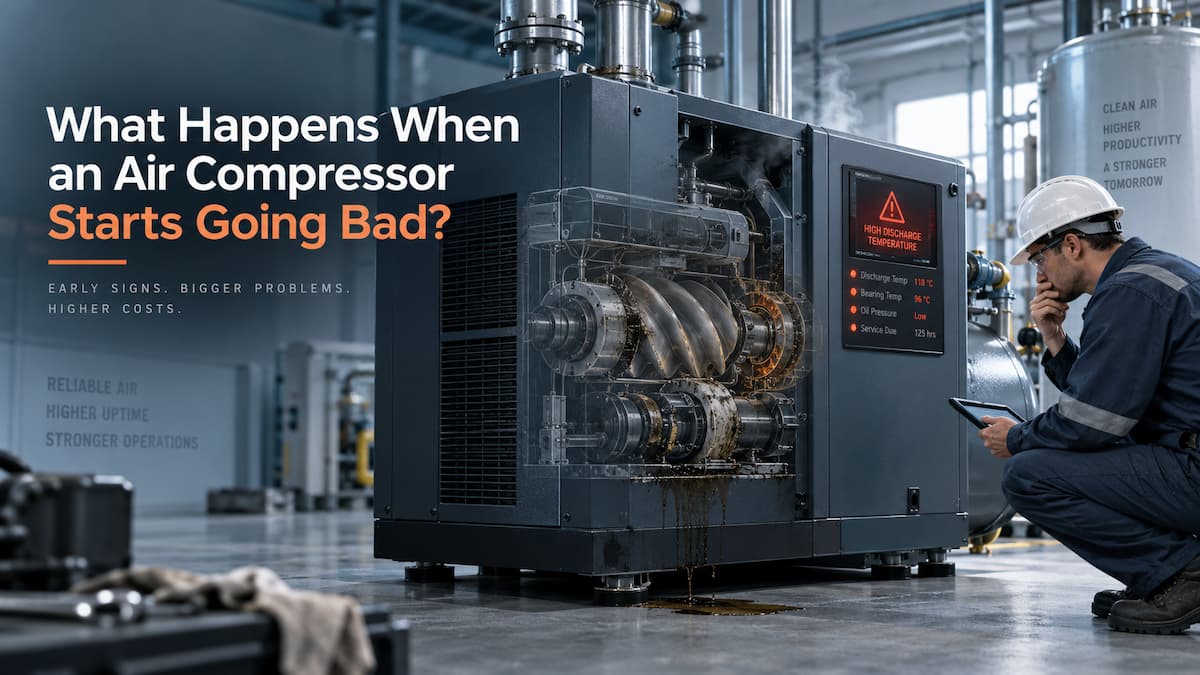
An air compressor rarely fails without warning. In most cases the machine gives clear signals for weeks or months before it stops working, and those signals are often ignored because the unit is still producing air. By the time output drops or the compressor shuts down, the damage has usually spread to more than one component.
This article explains what actually happens inside a compressor as it deteriorates, the effects on the rest of the plant, the common causes of failure, and how to decide between repair and replacement.
Early warning signs of a failing compressor
Most failures begin with small changes in how the machine runs. The following signs indicate that a compressor needs attention.
Longer run times to reach set pressure
If the unit takes noticeably longer to build pressure than it did when new, internal wear or a leak is reducing its efficiency.
Frequent cycling
A compressor that starts and stops more often than usual is either losing air somewhere in the system or failing to hold pressure in the receiver.
Unusual noise or vibration
Knocking, rattling, or a change in the normal running tone points to bearing wear, loose mounting, or damage inside the compression element.
Rising discharge temperature
Higher operating temperature usually indicates a cooling problem, low or degraded oil, or a blocked cooler.
Oil in the air line
Oil carryover means the separator element is saturated, damaged, or nearing the end of its service life.
Water in the discharge air
This points to a dryer fault or a drain that is no longer working, and it leads directly to corrosion downstream.
Higher electricity consumption for the same output
A worn compressor consumes more power to deliver the same volume of air. This is often the first measurable sign of decline.
What happens inside the machine
Different components fail in different ways, and each has a distinct effect on performance.
Air end or compression element wear
In a rotary screw compressor, the rotors and bearings inside the air end carry the entire load. As bearings wear, rotor clearances open up and the element leaks internally. Delivered air volume drops while power consumption stays the same or rises. If the bearings fail completely, the rotors can contact the housing, which usually destroys the air end.
In a reciprocating compressor, worn piston rings and valves allow compressed air to leak back into the cylinder. The machine runs continuously but never reaches full pressure.
Motor failure
Bearing wear, insulation breakdown, or repeated overheating leads to motor failure. Warning signs include tripping overloads, a burning smell, and difficulty starting under load.
Cooling system problems
Blocked coolers, failed cooling fans, or low coolant flow cause the discharge temperature to rise. High temperature accelerates oil breakdown, which in turn accelerates wear in every lubricated part. Most compressors will shut down on high temperature before permanent damage occurs, but repeated shutdowns indicate an ongoing fault.
Separator and filter blockage
A blocked separator element increases pressure drop across the compressor. The machine must work at a higher internal pressure to deliver the same output pressure at the outlet, which raises energy consumption. A saturated separator also allows oil to pass into the air system.
Valve and control faults
The inlet valve, minimum pressure valve, and pressure switch control how the machine loads and unloads. Faults here cause erratic behaviour such as continuous loading, failure to unload, or pressure that swings above and below the set point.
Air leaks in the system
Leaks are not a compressor fault, but they present as one. A system with significant leakage forces the compressor to run far longer than necessary, which shortens its life and increases running cost.
The effects on the rest of the plant
A failing compressor affects far more than the compressor room.
Reduced pressure at the point of use
Pneumatic tools, actuators, and packaging machines are rated for a specific working pressure. When supply pressure falls, cycle times increase and equipment may not operate correctly.
Poor air quality
Oil carryover and moisture in the line damage downstream equipment. In paint shops, food processing, and pharmaceutical work, contaminated air can also result in rejected batches.
Corrosion in the distribution system
Water in the pipework causes rust, which then travels through the system and blocks filters and valves.
Higher energy costs
Compressed air is one of the most expensive utilities in a plant. Electricity typically accounts for the majority of the total lifetime cost of ownership of a compressor. A worn machine that consumes ten to twenty percent more power represents a significant and continuing cost.
Unplanned downtime
If the compressor supplies a production line, its failure stops the line. In most plants the cost of lost production over a single day exceeds the cost of the repair itself.
Damage that spreads
Many compressor failures are progressive. Degraded oil damages bearings, worn bearings damage the air end, and a failed air end can send debris into the oil system and cooler. Early intervention is almost always cheaper than a full overhaul.
Common causes of compressor failure
Most failures trace back to a small number of causes.
- Missed or delayed servicing. Oil, oil filters, air filters, and separator elements all have defined service intervals. Running past these intervals is the single most common cause of premature failure.
- Wrong or contaminated lubricant. Compressor oil is formulated for the specific machine type. Using an unsuitable oil, or mixing oil types, causes carbon deposits and accelerated wear.
- Poor ventilation in the compressor room. Machines that recirculate their own hot exhaust air run permanently above their design temperature.
- Dust and contamination. Intake air carrying dust, moisture, or chemical vapour damages the air end and blocks coolers.
- Oversized or undersized selection. A compressor that is too large for the demand cycles excessively. One that is too small runs continuously without rest and wears out early.
- Untreated leaks. Leakage rates of twenty to thirty percent are common in older installations and place constant additional load on the machine.
- Electrical supply problems. Voltage fluctuation, phase imbalance, and frequent power interruptions shorten motor life. In many industrial locations this is a persistent problem and justifies proper power conditioning at the supply end.
What to do when problems appear
Record the symptoms before calling for service
Note the discharge pressure, discharge temperature, running hours, load and unload behaviour, and any error codes displayed on the controller. This information significantly shortens diagnosis time.
Check the simple items first
Confirm the air filter is clean, the oil level is correct, the cooler is free of dust, and the condensate drain is working. A meaningful share of reported faults are traced to one of these four points.
Survey the system for leaks
Measure how long the compressor runs when no equipment is in use. If it loads regularly during a shutdown period, the system is leaking.
Do not continue running a machine that is shutting down on a fault
Repeated high temperature or overload trips indicate an active problem. Continuing to run the unit converts a service item into a major repair.
Use the correct parts
Genuine filters, separators, and lubricants are matched to the machine. Substitute parts frequently cause the failures they were bought to avoid, and they may affect warranty coverage.
Repair or replace
The decision usually depends on four factors.
Age and running hours
A machine within its expected service life and supported by available spare parts is normally worth repairing. Once the model is out of production and parts are difficult to source, replacement becomes more practical.
Cost of the repair against the cost of a new unit
As a general guide, when a single repair approaches half the price of a new machine of similar capacity, replacement deserves serious consideration.
Energy performance
Compressor efficiency has improved considerably over the last two decades. A variable speed drive machine matched to an actual demand profile can reduce energy consumption substantially compared with an older fixed speed unit that loads and unloads all day. In plants with continuous operation, the energy saving alone can justify replacement.
Reliability requirements
If the compressor supports a production process where downtime is expensive, the case for replacing an unreliable machine is stronger than the repair cost alone would suggest.
Preventing failure
A structured maintenance approach avoids most unplanned failures.
- Follow the manufacturer service schedule based on running hours, not on calendar convenience
- Change oil, oil filters, air filters, and separator elements at the specified intervals
- Keep the compressor room clean, ventilated, and at a controlled temperature
- Check and clean the coolers regularly
- Test condensate drains and verify that the dryer is holding its dew point
- Monitor discharge pressure, temperature, and loaded hours and record the readings
- Carry out a leak survey at least once a year
- Maintain a small stock of consumable service parts to avoid waiting during a breakdown
- Ensure the electrical supply to the machine is stable and correctly rated
Lastly
An air compressor that is going bad first becomes inefficient, then becomes unreliable, and finally stops. Each stage is more expensive than the one before it. The running cost of a worn machine continues every hour it operates, and a failure at the wrong moment stops everything that depends on compressed air.
Regular servicing, accurate record keeping, and prompt attention to changes in pressure, temperature, and noise will keep a compressor working close to its rated performance for its full design life. Where a machine is already past that point, a comparison of repair cost, energy consumption, and downtime risk will usually make the right decision clear.
If your compressor is showing any of the signs described above, get in touch with our service team for an assessment.
Frequently asked questions
How long does an air compressor last?
A well maintained industrial rotary screw compressor commonly gives ten to fifteen years of service, and the air end itself can run for tens of thousands of hours before overhaul. Reciprocating units in light duty use last a similar number of years but fewer running hours. Maintenance quality affects the outcome more than the age of the machine.
Why is my compressor not building full pressure?
The usual causes are a blocked air filter, a leaking inlet valve, worn valves or piston rings in a reciprocating machine, internal wear in the air end of a screw machine, or leaks in the distribution system. Checking for leaks and inspecting the air filter should always come first.
Why is there oil in my compressed air?
This normally indicates a saturated or damaged separator element, an overfilled oil sump, a blocked separator drain line, or an air end that is passing oil past worn seals.
What causes a compressor to overheat?
Common causes are a blocked or dirty cooler, low oil level, degraded oil, a failed cooling fan, high ambient temperature, or poor ventilation in the compressor room.
Is it cheaper to repair or replace an old compressor?
Repair is normally the better option while the machine is within its service life and parts remain available. Replacement becomes the stronger option when repair costs approach half the price of a new unit, when parts are no longer supported, or when a newer and more efficient machine would recover its cost through lower energy consumption.