Every compressor produces wet air
Every compressor produces wet air. The air going in carries water vapour, and once it is compressed and cooled, that vapour turns into liquid. If it is not removed, it travels through your pipes and into your machines, causing rust, sticking valves, damaged tools, spoilt paint jobs and rejected products. That is the job of an air dryer.
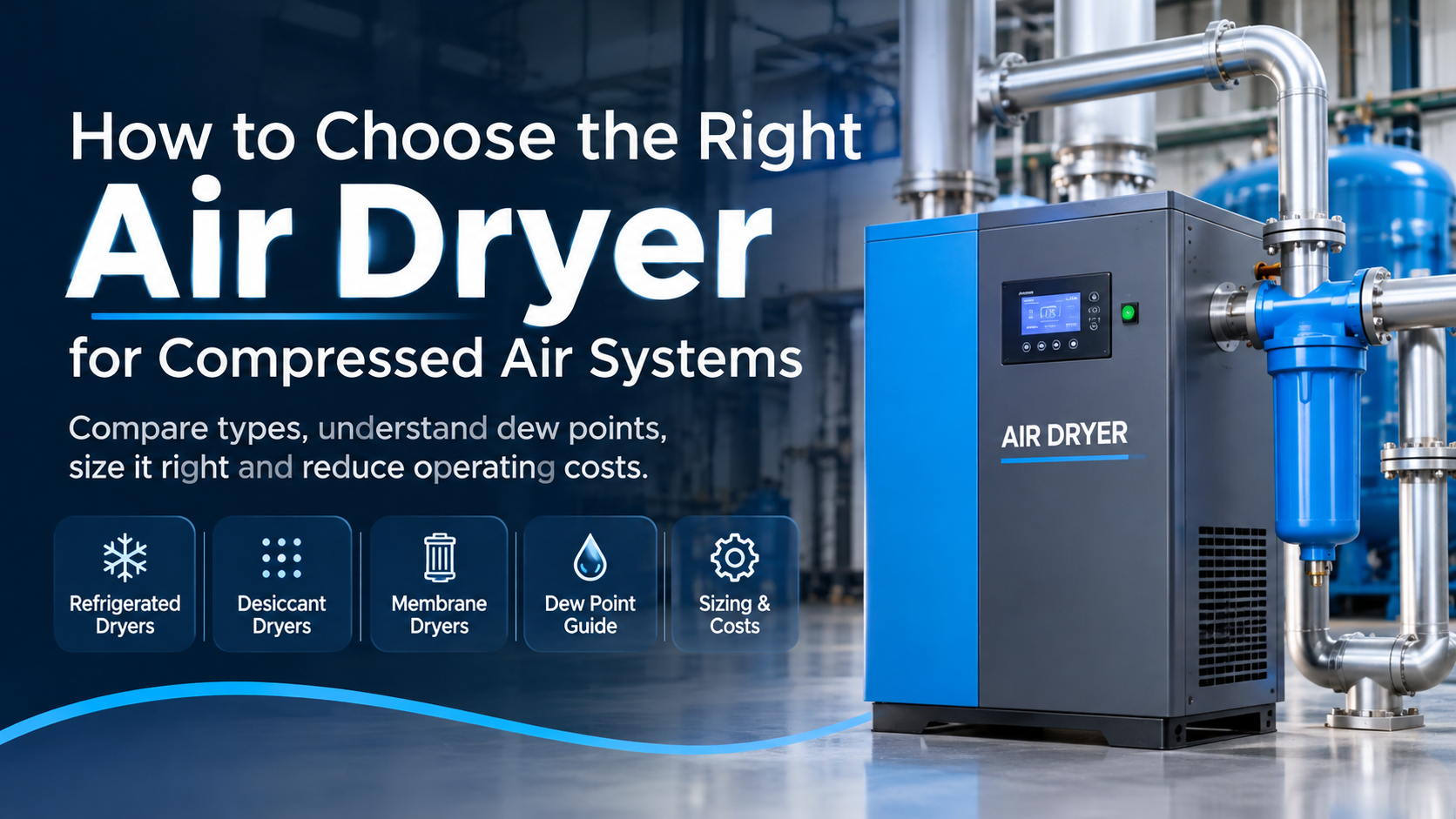
The difficulty is choosing one. The two main families, refrigerated and desiccant, differ widely in dryness, running cost and price, and the wrong choice either leaves moisture in your air or wastes money on dryness you do not need. This guide explains how each type works, how to decide what dew point you actually need, how to size a dryer for Indian conditions, what the real running costs are and which mistakes to avoid.
Start with the dew point, not the dryer
The measure of how dry compressed air is called its pressure dew point. It is the temperature at which the air, at system pressure, starts to drop water as liquid. A pressure dew point of +3°C means water will begin to condense if the air cools below +3°C. A dew point of -40°C means the air is extremely dry, and water will not condense until it reaches -40°C.
The right dew point is the one that keeps the air dry at the coldest temperature your pipes or your process will experience. A common rule of thumb is to choose a dew point at least 10°C below the lowest temperature the air will be exposed to. Anything drier than that costs more and gives no benefit. Anything less dry leaves a risk of condensation.
The main types of air dryer
Refrigerated dryers
A refrigerated dryer cools the compressed air to a few degrees above freezing, usually giving a pressure dew point of around +3°C. At that temperature most of the moisture condenses and is drained away, and the air is then reheated slightly so that pipes do not sweat.
- Best for: General plant air, tools, pneumatic machinery, packaging lines and most workshop and factory use in warm indoor environments.
- Advantages: Low purchase price, low running cost, simple, no air lost to purging.
- Limits: Cannot go below about +3°C, because water would freeze inside the dryer. Not suitable where air lines run through cold areas or where the process needs very dry air.
Some refrigerated dryers use variable or cycling operation so that power use falls when the load is light. If your air demand changes through the day, this can cut running cost.
Desiccant dryers
A desiccant dryer passes the air through a bed of drying material that adsorbs moisture. Typically there are two towers: one dries the air while the other is regenerated, and they swap roles on a cycle. This can give very low dew points, commonly -20°C, -40°C and sometimes -70°C.
- Best for: Instrument air, outdoor or unheated pipework, cold stores, pharma, electronics, paint and powder coating, food and beverage where low moisture is critical, and anywhere condensation would harm product or process.
- Advantages: Very dry air, a choice of dew points, works in cold conditions.
- Limits: Higher purchase price, higher running cost, regular replacement of the desiccant, and a cost for regeneration.
Desiccant dryers differ in how they regenerate:
- Heatless dryers use a portion of the dried air, called purge air, to regenerate the other tower. They are simple and reliable, but the purge air is lost, often a sizeable share of the dryer's rated flow. You pay for it in extra compressor energy.
- Heated dryers use an electric heater, along with a smaller amount of purge air or ambient air from a blower, to regenerate the bed. They use less compressed air but need electrical heating energy.
- Heat of compression (HOC) dryers use the heat that the compressor itself produces to regenerate the desiccant, so they can run with little or no purge air and little extra energy. They suit certain oil-free compressors that produce hot air at the outlet, and need to be matched to the compressor.
Membrane dryers
A membrane dryer passes air through fibres that let water vapour escape. They have no moving parts and need no power, but they use some of the dried air as purge and are generally suited to smaller flows and point-of-use applications, such as a single instrument or analyser. They are not normally used to dry the whole plant's air.
Comparing the types at a glance
| Type | Typical dew point | Best for | Watch out for |
|---|---|---|---|
| Refrigerated | About +3°C | General industrial air in warm, indoor settings | Not for cold areas or very dry air needs |
| Desiccant, heatless | -20°C to -40°C or lower | Instrument air, outdoor lines, sensitive processes | Purge air loss, desiccant replacement |
| Desiccant, heated | -40°C or lower | Large flows needing very dry air | Electrical heating energy, higher cost |
| Heat of compression | Depends on design and conditions | Suitable oil-free compressors, high running hours | Needs to match the compressor |
| Membrane | Moderate to low, depends on flow | Small, point-of-use needs | Not for whole-plant drying |
Which dew point does your application need?
These are general guides. Always confirm requirements with your process owner, your quality team and the manufacturer of your equipment.
- General workshop and factory air: A refrigerated dryer at about +3°C is usually enough, provided the pipework stays warmer than that.
- Packaging lines and pneumatic machinery: Mostly refrigerated, unless cold areas or sensitive products are involved.
- Spray painting and finishing: Moisture causes blisters and defects. Many shops use a refrigerated dryer with good filtration, while demanding finishes may call for a lower dew point.
- Instrument air: Often a lower dew point such as -40°C, particularly where lines run outdoors or through cooler zones.
- Pharmaceutical and food-contact air: Dew point is set by risk assessment and the quality system. Low dew points are common because they also limit microbial growth in pipes.
- Electronics and sensitive assembly: Often -40°C or lower.
- Cold rooms, cold stores and outdoor pipework in cooler regions: A dew point below the lowest temperature the lines will see.
Sizing a dryer for Indian conditions
Dryer capacity is not a fixed number. Manufacturers rate dryers at standard reference conditions, such as a particular inlet air temperature, ambient temperature and operating pressure. When your real conditions are hotter or the pressure is lower, the dryer's capacity falls, and the manufacturer provides correction factors to show by how much.
In much of India, and especially in humid cities like Mumbai, conditions are tougher than reference conditions for a good part of the year. A dryer that looks big enough on paper can fall short in summer. Size for the worst case:
- Inlet air temperature: The temperature of the air entering the dryer, in the hottest weather, taking into account the aftercooler performance.
- Ambient temperature around the dryer, which is often higher than outdoor air if it sits in a hot compressor room.
- Operating pressure, which may be below the dryer's reference pressure.
- Total air flow, including the flow from all compressors that feed the dryer, plus any growth you expect.
- Required dew point.
Apply the correction factors from the datasheet, and choose a dryer whose corrected capacity meets your total flow. Oversizing a refrigerated dryer by a modest margin does little harm. Undersizing it leads to wet air in exactly the hottest, most humid weather.
The real running cost
The price of the dryer is only the start. Look at what it will cost to run.
- Refrigerated dryers consume electricity for the refrigeration circuit, and cause a small pressure drop. Energy-saving models that adjust to load use less when the demand is light.
- Heatless desiccant dryers lose compressed air as purge, which has to be produced by the compressor. This is often the largest running cost.
- Heated dryers use electricity for the heater and blower.
- Desiccant replacement is needed periodically.
- Filters before and after the dryer need regular change, and add pressure drop.
Here is an illustrative example of how purge air adds up. Suppose a heatless dryer handles 10 m³/min and loses about 15% of its flow as purge, which is 1.5 m³/min. If compressed air costs about 6.5 kW per m³/min to make, that purge needs roughly 10 kW of compressor power. Running 6,000 hours a year at ₹8 per kWh, it comes to around ₹4.8 lakh a year. These numbers are invented to show the method, and your own purge rate and power cost will differ, but they show why a very dry dew point should be specified only where it is really needed, and why a dryer with lower purge or none, such as a heat of compression type, can pay back for plants with long running hours.
Installation: the details that affect performance
- Location: Keep the dryer in a cool, well-ventilated place. A refrigerated dryer in a hot, dusty compressor room loses capacity.
- Filtration: Fit a coalescing pre-filter ahead of the dryer to protect it from oil and water droplets, and, for desiccant dryers, an after-filter to catch desiccant dust.
- Drains: Use reliable automatic drains. A blocked drain defeats the purpose of the dryer.
- Bypass: A bypass line allows service without stopping the plant, but should be kept closed during normal operation. A forgotten open bypass is one of the most common causes of wet air.
- Pipe the dryer after the air receiver or as the supplier advises for your design, so the dryer sees steadier flow.
- Monitor: A dew point indicator or meter tells you if the dryer is performing. Without one, you are guessing.
Common mistakes
- Choosing by price alone. A cheap dryer that cannot reach the dew point you need is no bargain.
- Choosing a dew point that is too dry. A desiccant dryer where a refrigerated one would do wastes capital and energy.
- Choosing a dew point that is too wet. A refrigerated dryer on outdoor lines that get cold will let water freeze or condense.
- Sizing at reference conditions. Ignoring heat and humidity leaves you short in summer and monsoon.
- Skipping filters. Without pre-filters, oil and water droplets damage the dryer.
- Neglecting drains and maintenance. Dryers fail quietly. Blocked drains, dirty condensers and tired desiccant all reduce performance without any obvious alarm.
- Leaving the bypass open. The dryer sits idle while wet air flows around it.
- Ignoring the compressor. A hot, poorly cooled compressor discharge puts extra load on the dryer.
Maintenance routine
Daily: Check drains are discharging, and look at the dryer's indicators and any dew point reading.
Weekly: Clean the condenser surfaces on refrigerated dryers, particularly in dusty or lint-laden settings. Check the differential pressure across the pre- and after-filters.
Monthly: Record dew point and compare with previous readings. Inspect for leaks around the dryer.
As scheduled: Replace filter elements, service the refrigeration circuit and drains, and replace desiccant at the interval recommended by the manufacturer, which depends on running hours and conditions.
Questions to ask an air dryer supplier
- What dew point do you recommend for my application, and why?
- How did you size the dryer, and at what inlet and ambient conditions?
- What are the correction factors for my site in summer and the monsoon?
- What is the purge air or energy use, and what will that cost me per year?
- Which filters are included, and how often must they be changed?
- What does desiccant replacement involve, and at what interval?
- What is the pressure drop across the dryer?
- Is there a dew point indicator, and what alarms are provided?
- What service support and spares are available locally?
Frequently asked questions
Do I need a dryer if I have an oil-free compressor?
Yes. Oil-free compression removes oil, not water. The air is still wet when it leaves the compressor, and a dryer is still needed in almost all installations.
Is a refrigerated dryer enough for Mumbai?
For general industrial use in indoor, warm areas, a correctly sized refrigerated dryer is usually enough. It must be sized for the hottest, most humid conditions, not the average. If you have outdoor lines, cold areas or a sensitive process, a lower dew point desiccant dryer may be needed.
What is the difference between a dryer and a filter?
A dryer removes water vapour by lowering the dew point. A filter removes particles, liquid droplets and oil aerosols. Most systems need both, in the right order.
Can I install a dryer on an existing compressor system?
Usually yes. The dryer is added after the compressor and its aftercooler and receiver. The right size and position depend on your flow and layout, so it is best to have the system checked.
How do I know if my dryer is working?
Check the dew point with an indicator or meter, look at the drains and see whether water appears at your points of use. Water in tools or air lines on a humid day is a sign that the dryer is overloaded, bypassed or faulty.
How much does an air dryer cost?
The price depends on the type, the flow capacity and the dew point. Refrigerated dryers cost less than desiccant ones, and larger flows and lower dew points cost more. Share your air flow, pressure and dew point requirement to get a quotation that covers filters and installation too.
Next step
The right dryer is not the driest or the cheapest. It is the one that gives the dew point your process needs, at the lowest total cost, in the conditions your plant actually faces. Start with the dew point, size for your worst day and look at running costs alongside the price.
Airkom Agencies is an authorised Atlas Copco distributor in Mumbai, with stock points at Mahape and Vapi. Our range includes air dryers and filters alongside oil-injected and oil-free compressors, AIRnet piping, genuine parts and service. Ask for an air dryer recommendation or call +91 79779 90375.