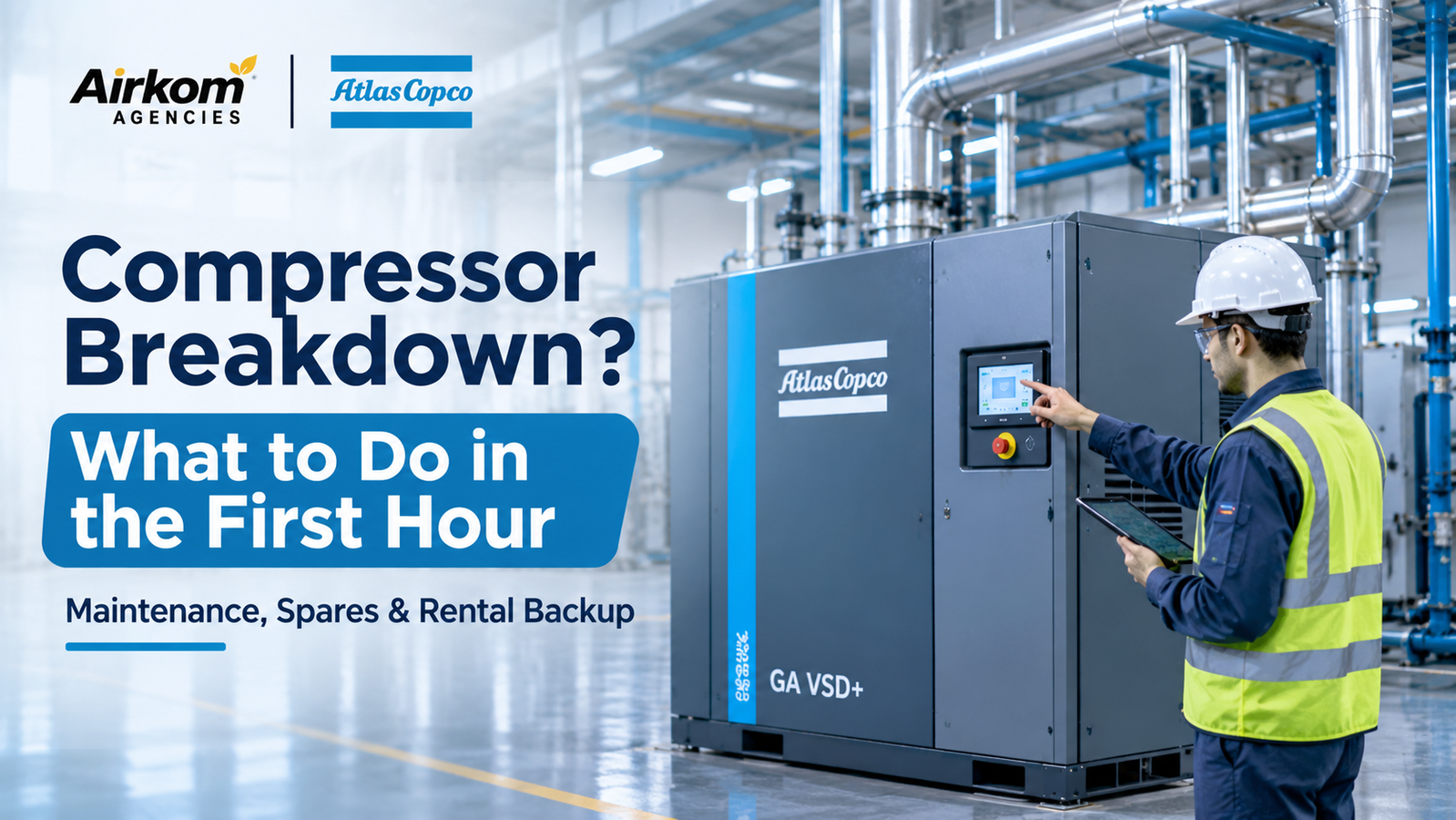
It is a Tuesday morning and the line is running well. Then the compressor trips. The pressure falls, the machines stop one by one, and within minutes the whole shop floor is waiting for air. Everyone looks at the maintenance head.
If your plant is in Navi Mumbai, Thane, Panvel or the surrounding industrial belt, this is a situation worth being ready for. This guide covers what to do in the first hour after a compressor stops, how to tell what has probably gone wrong, what to do about production while repairs are under way, and how to set up annual maintenance, genuine spares and rental backup so that the next breakdown is shorter or never happens.
The first hour: a practical checklist
Your first actions decide whether this is a minor interruption or a long stoppage. Work through these steps calmly and in order.
1. Make the area safe
Compressors hold pressurised air, hot oil and live electrical equipment. Do not open pressurised parts, loosen fittings or remove covers while the machine is under pressure or powered. Only trained people should work inside the machine. If there is a burning smell, smoke, oil leak or unusual noise, stop the machine with the emergency stop and isolate the power.
2. Read the controller, and record what it says
Modern compressors display warnings and fault codes. Note exactly what is shown: the message, the code and the time. Photograph the screen if possible. This is the most useful piece of information for the service engineer, and it can disappear if the machine is switched off and restarted.
3. Do not keep restarting the machine
It is tempting to press start repeatedly. If the machine stopped because of high temperature, low oil, a blocked element or an electrical fault, repeated restarts can turn a small problem into serious damage. Restart once only when the cause is clear and the alarm has cleared.
4. Check the simple things first
- Power: Is the supply present on all phases? Has a breaker, fuse or overload relay tripped? Was there a voltage dip or outage?
- Temperature: Is the compressor room very hot? Are the cooler fins covered in dust or lint? Is the ventilation blocked?
- Oil: Is the oil level normal? Is there visible oil leakage?
- Intake: Is the air filter clogged? Is the service indicator showing red?
- Drains: Are the condensate drains discharging, or is water backing up?
- Emergency stop and panel: Has an emergency stop been pressed, or a panel door left open triggering an interlock?
5. Gather the details for your service provider
Before you call, have these ready:
- Compressor model and serial number (from the nameplate)
- Running hours and the date of the last service
- Fault code or message on the display
- When and how it stopped, and anything unusual just before
- Your location and a contact person at the site
This saves time on the phone and often lets the engineer bring the right parts on the first visit.
6. Protect production while you wait
Decide which users of compressed air are critical and which can wait. If you have a second compressor, check whether it can take the load, even in part. Shut off non-essential uses to conserve air. If you have no backup, ask about a rental unit straight away, because arranging one takes time.
Reading the symptoms
The following table gives common causes for common symptoms. It is only a guide, because the exact cause needs a proper inspection.
| What you see | Common causes |
|---|---|
| Trips on high temperature | Dirty cooler, hot or poorly ventilated room, low oil, failed fan, blocked oil filter |
| Pressure will not build up | Large leak, intake valve or unloader fault, clogged intake filter, worn element, wrong settings |
| Motor does not start | Tripped breaker or overload, supply fault, control fault, emergency stop active |
| Oil in the air lines | Worn or blocked separator element, high oil level, scavenge line problem |
| Water in the air lines | Dryer fault, failed drain, undersized dryer, hot compressor room |
| Frequent loading and unloading | Small receiver, leaks, incorrect pressure band, control settings |
| Unusual noise or vibration | Worn bearings, loose parts, coupling issue, low oil |
| Sudden rise in electricity use | Leaks, clogged filters, higher pressure setting, failing element |
What a breakdown really costs
Repair cost is usually the smaller part of the loss. The larger cost is production that does not happen.
Take an illustrative example. Suppose a line generates production worth ₹3 lakh per hour and the compressor is down for six hours. That is ₹18 lakh of lost output, before counting wasted material, overtime to catch up, late delivery penalties and the emergency charges for urgent parts and engineers. These figures are invented, but the pattern is real: a short stoppage on a busy line can cost more than the annual maintenance of the machine.
That is why plants that run continuously or on tight delivery schedules usually spend more time on prevention than on repair.
Why compressors fail: the pattern behind most breakdowns
Most breakdowns have causes that could have been seen earlier:
- Missed or late service. Oil, oil filters, air filters and separators are replaced after their time, not on it.
- Heat. Dirty coolers and poor ventilation in the compressor room, particularly in the summer months.
- Dust and lint. Clogged filters and coolers, common around industrial estates and construction zones.
- Moisture. Coastal humidity, a weak dryer or blocked drains, leading to water in the system.
- Wrong or poor-quality spares. Fits the housing, but does not perform.
- Power problems. Voltage swings and outages stress motors and electronics, especially during the monsoon.
- Ignored warnings. Alarms or warning messages that were cleared without finding the cause.
Preventing the next breakdown
Service by running hours
Compressors need oil, filter and separator changes at set running-hour intervals, as set out in the manufacturer's service schedule. Calendar-based reminders are not enough, because a machine that runs three shifts reaches its interval much sooner than one that runs one. Track running hours and plan each service ahead of time.
Keep the machine cool and clean
Clean the coolers regularly. Make sure the compressor room has fresh air coming in and hot air going out. Do not store anything that blocks the airflow. Check the room temperature on hot afternoons.
Watch the small signs
Rising temperature, growing pressure drop across filters, longer loading times and increasing power consumption are all early warnings. A simple weekly log of readings reveals trends long before a trip.
Look after the air treatment
Dryers, filters and drains protect the compressor and everything downstream. Check drains daily in humid periods, watch filter differential pressure and keep dryer dew point readings on record.
Train the operators
Operators who know what normal looks like, and who report unusual noises, smells or readings immediately, are the cheapest early-warning system you can have.
Annual maintenance contracts (AMC): what to look for
An AMC turns maintenance from something you remember into something that happens. But contracts vary a great deal, so compare what is covered and not just the price. Ask:
- Visits: How many scheduled visits per year, and are they linked to running hours?
- Parts and consumables: Which are included, such as oil, filters and separators, and which are billed separately?
- Breakdown response: Is there a committed response time? What happens outside normal hours?
- Genuine parts: Are they used, and is that stated in writing?
- Equipment covered: Only the compressor, or also dryers, filters, receivers and controllers?
- Reports: Do you receive a service report after each visit, with findings and recommendations?
- Exclusions: What is not covered, such as major component failures?
- Engineer qualification: Are the engineers factory trained for your machines?
A cheap contract that excludes most parts and gives no response commitment may cost more in the end than a complete one.
Genuine spares: what to keep in stock
For critical compressors, a small stock of common wear items on your shelf can turn a day of waiting into an hour of work. Typical items include:
- Oil and oil filters
- Air filter elements
- Oil separator elements
- Drain valves or drain kits
- Dryer and line filter elements
- Belts, hoses and gaskets where used on your model
Ask your service provider for a list based on your model and running hours. Use genuine parts, because copies may fit but can perform poorly. A weak separator lets oil carry over into the air system. A poor filter lets dirt reach the screw element. The money saved on a cheap part is small compared with the cost of a failure.
Rental backup: when it is the right call
Renting a compressor is often the fastest way to keep production going when your own machine is down. It also helps during planned overhauls and short peaks in production. If your plant cannot tolerate long stoppages, decide in advance:
- Who you will call, and what information they need
- What capacity and pressure you need, and what air quality
- Where the unit will be placed, and how it will connect to your piping
- What power supply and cooling it needs
- Who handles servicing during the rental
Availability depends on the machine and the time, so it is wise to talk to your supplier before an emergency, not during one.
Why a nearby service partner matters in Navi Mumbai and Thane
The industrial belt from Thane through Turbhe, Rabale and Mahape to Taloja and Panvel is busy, and traffic on the Thane-Belapur Road and nearby highways can turn a short distance into a long trip. When a compressor fails, the time it takes for an engineer and parts to reach you decides how long the stoppage lasts.
That is why proximity counts when choosing a service provider. Ask where engineers start their day, where spares are stored, and how long the usual response takes to your area. A stock point close to the industrial belt can make the difference between a same-day fix and waiting for parts from another city.
Airkom Agencies, an authorised Atlas Copco distributor, has a stock point at Mahape in Navi Mumbai, a head office in Parel, Mumbai, and a branch and stock point in Vapi. Since 1987 the company has completed more than 1,000 installations for over 800 industrial clients. Our range covers oil-injected and oil-free screw compressors, dryers, filters, AIRnet piping and genuine parts, together with service, maintenance and rentals.
A simple breakdown-readiness plan
- Write down your machine details: model, serial number, running hours and last service date, and keep them where operators can find them.
- Save your service partner's number and their escalation contacts in the plant control room.
- Agree an AMC that covers scheduled service by running hours and gives a breakdown response commitment.
- Stock critical spares and keep a list of what you hold.
- Identify critical air users so you know what to protect first in an emergency.
- Plan a backup: a standby compressor, a rental arrangement, or both.
- Keep a weekly log of pressure, temperature, filter readings and drain checks.
- Review once a year to see whether your machines, contract and spares still match your plant.
Frequently asked questions
My compressor tripped. Can I just restart it?
Only once, and only if the cause is clear and the alarm has cleared. Repeated restarts after a high temperature, low oil or fault trip can cause damage. Note the fault code and call your service provider if the problem returns.
How often should a screw compressor be serviced?
According to the manufacturer's schedule for your model, based on running hours and operating conditions. Dusty, hot and humid conditions may call for more frequent checks of filters, coolers and drains, even if the main service interval stays the same.
Is an AMC worth it for a single compressor?
Usually yes, if the compressor is important to production. The contract brings scheduled service, better access to engineers and often lower total cost than paying for each call-out separately. The more critical the machine, the stronger the case.
Can you service compressors that were not bought from you?
For Atlas Copco machines, genuine spares and service are available through the distributor network. Contact the team with your model and serial number to check what support applies.
Can I rent a compressor at short notice in Navi Mumbai?
Rentals are part of the service range, but availability depends on the machine you need and the timing. It is best to discuss your likely requirement in advance so that a plan is in place.
What spare parts should I keep at the plant?
Oil, oil filters, air filters and separator elements are the usual starting point, along with drain kits and dryer filter elements. Your service provider can suggest a list based on your model and running hours.
Next step
You cannot prevent every failure, but you can make sure that a failure is short, planned for and well understood. Know your machine details, keep your service on schedule, hold the right spares and have a backup ready before you need one.
Airkom Agencies provides compressor service, annual maintenance plans, genuine Atlas Copco spares and rentals for plants across Navi Mumbai, Thane, Mumbai and Gujarat. Talk to our team about a service plan or call +91 79779 90375.