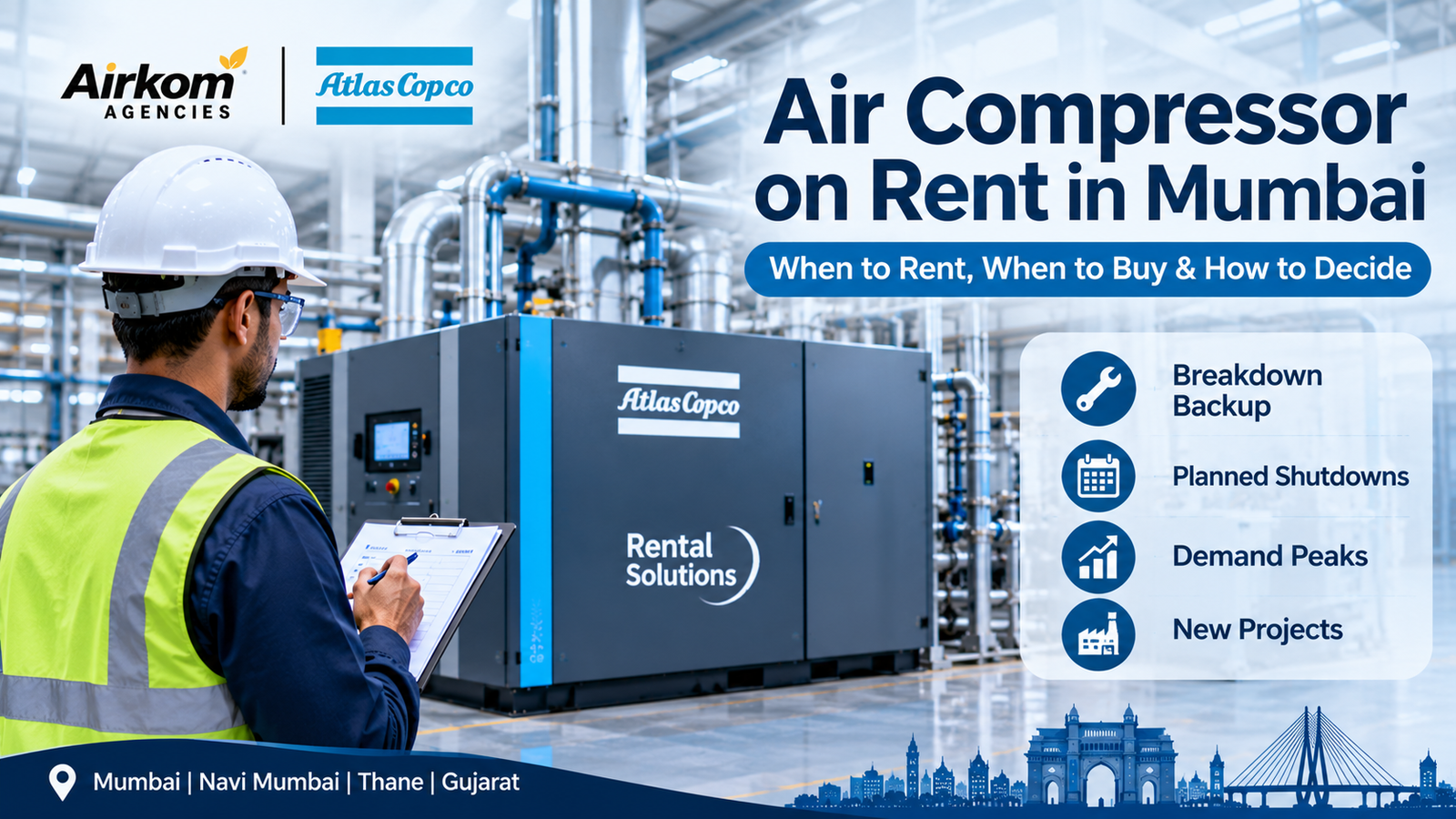
Most plants think of buying a compressor, not renting one, until the day they need one urgently. The main machine fails on a Friday, a shutdown is coming up, an order doubles production for two months, or a new line needs air before the permanent compressor arrives. In moments like these, renting an air compressor in Mumbai can be the fastest and cheapest way to keep things moving.
But renting is not always the right answer, and it is easy to get wrong if you decide in a hurry. This guide explains when renting makes sense, how to compare rent against buy using simple arithmetic, what to specify so you receive the right machine, what to prepare at your site, which contract terms to check and the questions to ask any rental supplier.
When renting an air compressor makes sense
1. Your compressor has broken down
This is the most common reason. If repairs will take days or longer, for example while parts are ordered or an element is rebuilt, a rental unit keeps production going. The earlier you arrange it, the shorter the stoppage.
2. Planned shutdowns and overhauls
When your main compressor goes in for a major service or overhaul, a rental unit covers the gap. Because the date is known, you can plan delivery, connection and testing in advance, with no panic.
3. Temporary peaks in demand
Festival season orders, seasonal production, large one-off orders and short projects can push demand above your installed capacity for a few weeks or months. Buying a machine for a short peak leaves you with unused capacity afterwards, while renting matches the cost to the need.
4. New lines or expansions waiting for permanent equipment
If a new line starts before the permanent compressor and piping are ready, a rental unit bridges the gap so that commissioning does not wait.
5. Trial before you buy
If you are not sure how much air you need, or whether a particular machine type suits your plant, running a rental unit on your real load gives you data before you commit to a purchase. It is a way to test a VSD machine, for example, against your demand pattern.
6. Construction, civil and project work
Projects that need compressed air for a limited period, such as tank cleaning, blasting, pipeline testing or site works, rarely justify owning a compressor.
7. Capital constraints
Some businesses would rather treat compressed air as an operating expense than a capital purchase, at least for a time. Renting can free up money for other priorities.
When buying is usually the better choice
- The air demand is permanent and continuous
- You would be renting for more than a year or two
- The compressor is central to production, and you need full control over service and availability
- You need a specific configuration, such as particular air quality, that a rental fleet does not offer
- Total rental payments would approach the price of a new machine
How to compare rent and buy with simple arithmetic
You do not need a complicated model. Start with the break-even point.
Break-even months = purchase price of the machine (with air treatment and installation) divided by the monthly rental.
If you expect to need the compressor for fewer months than that, renting is likely cheaper. If you expect to need it for longer, buying tends to win.
Here is an illustrative example with made-up ratios. Suppose a rental costs about 5% of the purchase price each month. The break-even is then 20 months. A project lasting six months would be far cheaper to rent. A permanent line running for ten years would be far cheaper to buy.
Then adjust for what the simple formula leaves out:
- Running costs: Electricity (or fuel) is paid either way, but check whether the rental price includes service, and whether the rental machine is as efficient as one you would buy.
- Service and spares: Owned machines need servicing at your cost. Rented machines are usually serviced by the supplier, so confirm this.
- Installation and piping: Buying involves permanent installation. Renting involves temporary connection, which is cheaper but may also have a cost.
- Cost of capital: Money spent on a purchase cannot be used elsewhere.
- Downtime risk: A rental fleet can replace a failing unit. An owned machine cannot, unless you hold a spare.
- Resale value: An owned machine keeps some value at the end of its life.
What to specify so you get the right machine
Giving the supplier the right details is the quickest way to receive a machine that works the first time. Prepare these:
- Air delivery: How much air you need, in cubic metres per minute or cubic feet per minute. If you do not know, say which machines it will supply and what compressor it replaces.
- Working pressure: The pressure your process requires at the point of use, in bar.
- Air quality: Is oil-free air required? What dew point or purity class do you need? This decides whether dryers and filters must come with the unit, and whether an oil-free machine is needed.
- Power and drive: What electrical supply is available, and what rating can your panel provide? Ask what kinds of machine can be supplied for your site.
- Duration: How long you expect to need it. Be honest about uncertainty, and ask about extensions.
- Operating hours: Single shift, two shifts or continuous.
- Site details: Location, access for delivery, whether the unit will be indoors or outdoors and the distance to your existing air network.
Air quality: do not forget dryers and filters
A common mistake is to rent a compressor and plug it straight into the line. Compressed air straight out of a compressor is warm and wet, and in Mumbai's humid climate the amount of water is considerable. Without a dryer and filters, moisture and dirt travel into your machines.
When you ask for a rental, ask whether a dryer and filters can be supplied together with the compressor, or whether your existing dryer has enough capacity to handle the extra flow. If your process needs oil-free air, make sure the rental unit and the filtration meet the requirement, and check how this can be shown.
What to prepare at your site
A smooth installation depends on a few things being ready before the machine arrives.
- Location: A level, stable place with enough space around the machine for airflow and access. Indoors, check ventilation, because compressors give off a lot of heat.
- Power: A suitable supply with the right cable, protection and a qualified electrician for the connection.
- Connection point: A valve and tapping on your air line where the unit will connect, and a clear route for hoses or pipe.
- Drainage: A way to dispose of condensate safely.
- Access: A route wide enough for the delivery vehicle, plus a crane, forklift or ramp if needed. Industrial lanes in older parts of Mumbai can be narrow, so check this in advance.
- Permissions: Gate passes, delivery time windows and any safety induction your site requires.
- Protection: If it will be outdoors during the monsoon, a canopy or shelter protects the electrics and controls.
Contract terms to check
Rental agreements differ. Read the details before you sign, and ask about:
- Minimum rental period and what happens if you need it for a shorter or longer time
- Rate structure: Daily, weekly or monthly, and whether there is a running hours limit with extra charges beyond it
- Delivery, installation and collection charges
- Power or fuel: Who pays, and what is included
- Service during the rental: Who maintains the machine, and how quickly will they respond
- Breakdown replacement: If the rental unit fails, do you get a substitute, and in what time
- Deposit and payment terms
- Responsibility for damage, misuse or loss, and any insurance requirements
- Operator training: What instructions do you receive on running it?
- Option to buy: Can the rental be converted to a purchase if you decide to keep the machine, and are any rental payments credited?
Renting in an emergency: how to make it fast
When a breakdown has already happened, speed matters more than anything else. To get a unit quickly:
- Call your supplier early, before the diagnosis is complete, and describe your requirement.
- Have your air quantity, pressure and site location ready.
- Prepare the connection point and power while the machine is in transit.
- Make sure someone is available at the gate to receive and place it.
- Ask for installation support, so that the machine is running soon after it arrives.
Because availability depends on the machine you need and the day you ask, plants with critical production often agree on rental arrangements in advance, and keep the details ready, so that an emergency becomes a phone call and not a search.
Using a rental to make a better purchase decision
A rental period can double as a measurement exercise. While the unit runs on your real load, you can:
- Log power and air demand to see your actual profile
- Test the effect of a lower pressure setting
- Try a VSD machine against your demand pattern and see how it behaves in practice
- Check whether your existing dryer and piping can handle the flow
- Find out whether your plant really needs the capacity you thought
If you then decide to buy, you do so with data. Ask your supplier whether rental periods can be set up with this in mind.
Questions to ask any rental supplier
- What machine will you supply for my air quantity and pressure, and is it oil-free if I need that?
- Can you supply a dryer and filters with it?
- How fast can you deliver to my location?
- Who installs, who connects and who trains my operators?
- How is the rental priced, and what is included?
- Is there an hours limit?
- How is service handled during the rental, and what is your breakdown response?
- What happens if the rental unit itself fails?
- Can I extend or end early without penalty?
- Can the rental lead to a purchase?
Rent, buy or both: a quick guide
| Your situation | Usual best choice |
|---|---|
| Main compressor has failed and repair will take days | Rent a backup unit now |
| Planned overhaul of your main compressor | Rent for the overhaul period |
| Seasonal peak lasting a few months | Rent |
| New line waiting for permanent equipment | Rent as a bridge |
| Unsure of true air demand | Rent to measure, then decide |
| Permanent, continuous demand | Buy |
| Production cannot tolerate any air outage | Buy, and also arrange rental or standby cover |
Serving Mumbai, Navi Mumbai, Thane and Gujarat
Airkom Agencies is an authorised Atlas Copco distributor with its head office in Parel, Mumbai, stock points at Mahape and Vapi, and a branch in Vapi. Since 1987 the company has completed more than 1,000 installations for over 800 industrial clients. Alongside compressors, dryers, filters and AIRnet piping, the range of services includes rentals, genuine spare parts, service and maintenance, so that a rental can be matched with the right air treatment and supported by the same team.
Frequently asked questions
How quickly can I get an air compressor on rent in Mumbai?
It depends on the machine you need, its availability and your location. In an emergency, contact the supplier as early as possible with your air quantity, pressure and site address, and have power and the connection point ready.
What does it cost to rent an air compressor?
The rate depends on the size and type of machine, the rental period, the hours of use and the services included. The only reliable way to get a price is to share your requirement and ask for a quotation that lists exactly what is covered.
Can I rent an oil-free compressor?
Where your process needs oil-free air, say so at the start. Availability and configuration depend on the supplier's fleet, so ask what can be provided and how the air quality is assured.
Does the rental include a dryer and filters?
Not always. Ask whether they are included, and whether your existing treatment equipment can cope with the extra air flow.
Who services the machine during the rental?
This should be set out in the agreement. In most cases the supplier handles servicing and breakdown support, but confirm it, along with the response time.
Can I buy the machine after renting it?
Some suppliers allow it. Ask in advance, and check whether any rental already paid can be credited against the purchase price.
Next step
Renting is not a second-best option. For the right situation, whether an emergency, a shutdown, a peak or a trial, it is often the smartest one. The key is to decide before the pressure is on: know your air quantity and pressure, know who you will call and have your connection point ready.
Airkom Agencies can advise on whether renting or buying suits your plant, and can help you with the right machine, air treatment and support. Enquire about an air compressor on rent or call +91 79779 90375.