Blog
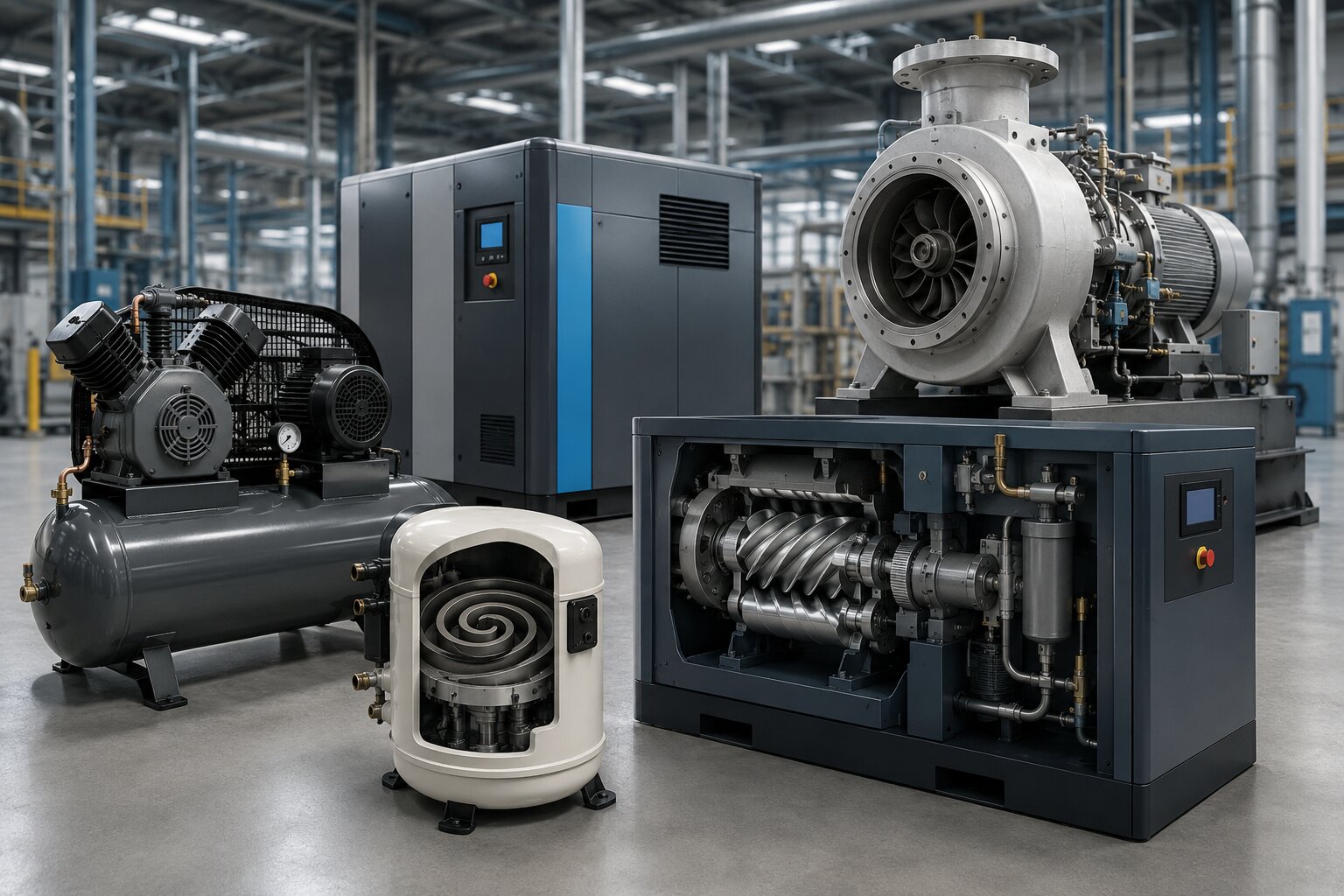
Types of air compressors compared: Reciprocating, screw, scroll and centrifugal
Ask five different plant managers which air compressor is "the best," and depending on what runs on their line, you will get five different answers. A print shop running a single spray gun for an hour a day has nothing in common with a pharmaceutical packaging line that needs oil free air around the clock. The types of air compressor available exist precisely because no single design handles every situation well.
This guide compares the four main compressor technologies, how each one actually compresses air, and which situations each is built for.
Reciprocating (piston) compressors
A reciprocating compressor uses a piston moving inside a cylinder, the same basic mechanism as a car engine in reverse. As the piston pulls back, it draws air in. As it pushes forward, it compresses that air and pushes it out through a valve. Most small workshop compressors and single phase units use this design.
Where it fits
Reciprocating compressors handle intermittent use well: a tool running for a few minutes at a time with gaps in between. They cost less upfront than screw compressors of similar output, but they run hotter, need more frequent maintenance, and struggle with continuous, all day demand. A small fabrication shop running a nail gun and occasional spray gun is a good fit. A production line that never stops is not.
Rotary screw compressors
A screw compressor uses two interlocking helical rotors that mesh together, trapping air between them and squeezing it into a smaller space as the rotors turn. Because the compression happens continuously as the rotors spin, rather than in the start-stop cycle of a piston, screw compressors run cooler and handle sustained demand far better.
Where it fits
This is the default choice for most medium to large industrial operations running compressed air continuously across a shift. Atlas Copco's G and GA ranges cover this category, from smaller units like the G 2-5 for lighter industrial use up to variable speed models like the GA 7-75 VSD, which adjusts rotor speed to match actual demand rather than running flat out constantly.
Scroll compressors
A scroll compressor uses two spiral shaped elements. One stays fixed while the other orbits around it, and the space between the two spirals shrinks as air moves toward the centre, compressing it along the way. There's no piston slapping back and forth and no meshing rotors, which is why scroll compressors run noticeably quieter than the other two designs.
Where it fits
Scroll technology is inherently oil free by design, since there's no need for oil to seal a piston ring or lubricate meshing rotors. That makes it a strong fit for dental clinics, laboratories, and small scale operations where noise and air purity both matter, and where the compressed air volume needed is modest.
Centrifugal compressors
A centrifugal compressor works on a completely different principle. A high speed impeller spins and flings air outward at high velocity, and that velocity gets converted into pressure as the air is forced through a diffuser. There's no piston, rotor, or spiral involved at all.
Where it fits
Centrifugal compressors are built for very high, continuous volume, well beyond what most factories need. They show up in large scale industrial plants and utility-level applications where output requirements are consistently high. For most mid sized manufacturers, this category is more capacity than the plant will ever use.
Comparing the four at a glance
| Type | Duty cycle | Noise level | Typical use case |
|---|---|---|---|
| Reciprocating | Intermittent | Higher | Small workshops, occasional tool use |
| Rotary screw | Continuous | Moderate | Medium to large industrial plants |
| Scroll | Light to moderate, continuous | Low | Labs, clinics, oil free small scale needs |
| Centrifugal | Continuous, very high volume | Moderate to high | Large industrial and utility scale plants |
Oil injected or oil free within each type
Reciprocating and screw compressors are available in both oil injected and oil free versions, while scroll compressors are oil free by design. If your compressed air will ever touch a product, packaging, or a sensitive process directly, the oil free question matters more than which mechanical type you choose. We cover that decision separately in our oil injected vs oil free compressor guide.
How Airkom Agencies can help
As an Atlas Copco authorised distributor, Airkom Agencies supplies reciprocating, rotary screw, and scroll compressor ranges, along with the air dryers and filtration to complete the system. Our team sizes the right technology and capacity to your actual shift pattern and application, rather than defaulting to the largest available unit.
Explore our oil injected compressors and oil free compressors ranges.
Frequently asked questions
Which compressor type is cheapest to buy?
Reciprocating compressors typically have the lowest upfront cost for a given output, but they cost more to run and maintain under continuous, heavy use compared to a screw compressor.
Are screw compressors always better than reciprocating ones?
Not always. Screw compressors are better suited to continuous, high demand use, but for a small workshop with intermittent, low volume needs, a reciprocating compressor can be the more cost effective choice.
Is a scroll compressor powerful enough for a small factory?
It depends on the volume required. Scroll compressors work well for light to moderate continuous demand, such as labs or clinics, but larger production floors typically need the higher output of a screw compressor.
Do I need a centrifugal compressor for my plant?
Most mid sized manufacturers don't. Centrifugal compressors are built for very high, continuous volume beyond what typical factories need, and are more common in large industrial or utility scale settings.
Can I mix compressor types in one facility?
Yes. Some plants run a large screw compressor for the main production line and a smaller scroll unit for a lab or quality control area that needs oil free air specifically.