Blog
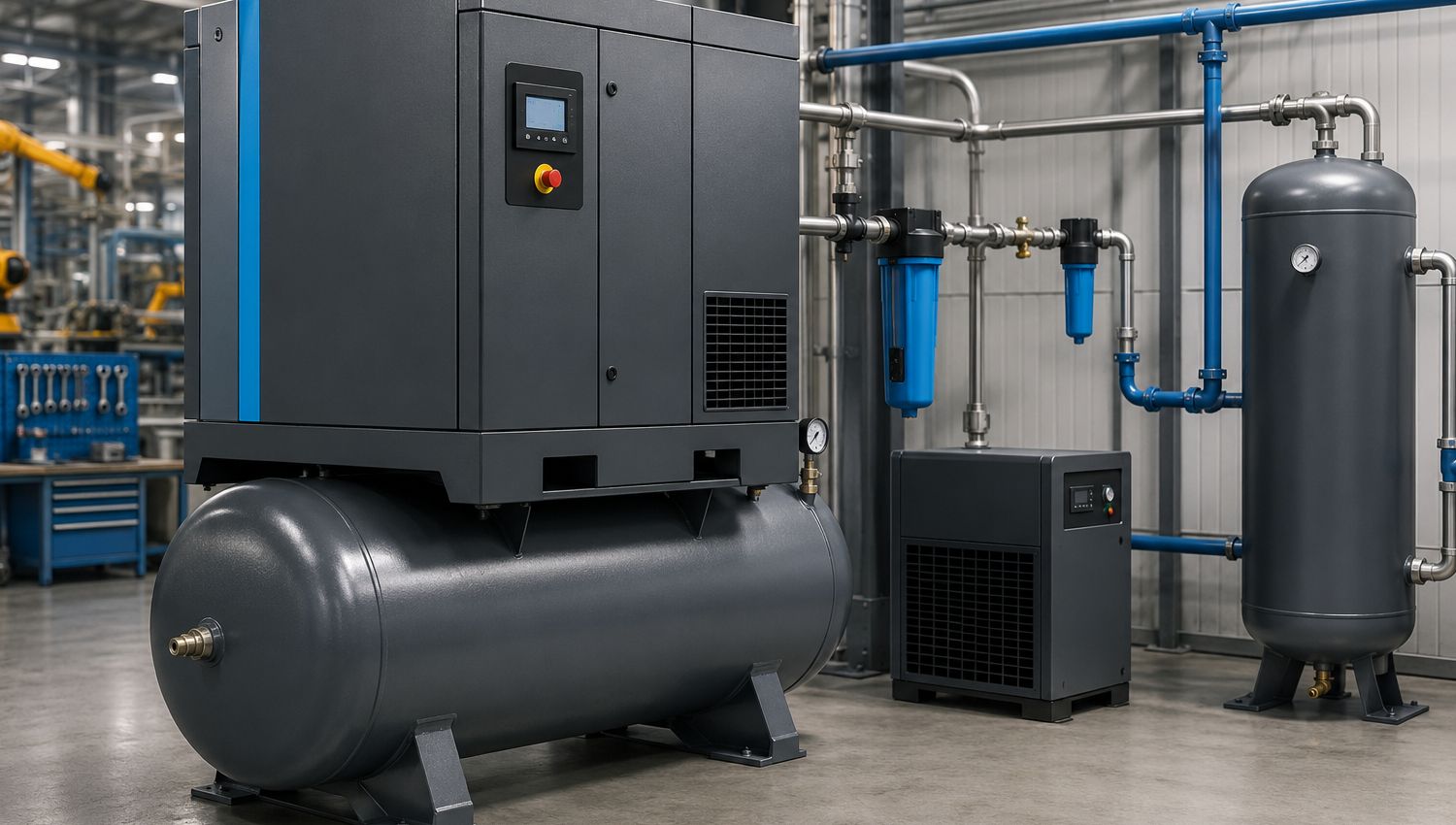
What is an Air Compressor? How it works (Beginner's Guide)
Nearly every factory, workshop, and industrial plant runs on compressed air somewhere, powering tools, actuating valves, or running automated machinery. Yet most people who rely on it every day have never actually asked: what is an air compressor, and how does it turn ordinary air into a usable power source?
This guide covers the basics: what an air compressor does, how it works, and the different types you'll come across when choosing one for your business.
What is an air compressor?
An air compressor is a machine that takes in air at normal atmospheric pressure and reduces its volume, which increases its pressure. That pressurised air is then stored or delivered through a piping network to power tools, machinery, and industrial processes. In simple terms, it converts electrical or mechanical energy into potential energy stored in pressurised air.
How does an air compressor work?
The internal mechanism varies by type, but every air compressor follows the same basic sequence:
- Intake: air is drawn in from the atmosphere through an intake filter.
- Compression: the air is mechanically squeezed into a smaller volume, raising its pressure and temperature.
- Cooling: the compressed, heated air passes through a cooler to bring its temperature down.
- Storage or delivery: the cooled, pressurised air moves to a storage tank, called a receiver, or directly into the piping network for immediate use.
What is an air compressor used for?
Compressed air is often called the fourth utility in industrial plants, alongside electricity, water, and gas. A screw press running continuously through a shift pulls air very differently than a hand tool used for ten minutes an hour, and matching the right compressor to that actual usage pattern matters more than simply buying the largest machine available. Common air compressor uses include:
- Powering pneumatic tools such as drills, grinders, and spray guns
- Operating pneumatic actuators and valves on automated production lines
- Packaging and material handling equipment
- Cleaning and blow off applications
- Powering paint spray booths and finishing equipment
- Critical processes in pharma, food, and electronics manufacturing where air purity matters
Types of air compressors
| Type | How it compresses air | Best for |
|---|---|---|
| Rotary screw | Two interlocking rotors squeeze air between them | Continuous industrial use, medium to large plants |
| Reciprocating (piston) | A piston compresses air inside a cylinder | Intermittent use, workshops, smaller applications |
| Scroll | Two spiral elements compress air between them | Low noise, oil free applications like labs and clinics |
| Centrifugal | A high speed impeller accelerates air, converting velocity to pressure | Very high volume, continuous industrial demand |
Atlas Copco's range spans all of these categories. On the oil injected screw side alone, models like the compact G 2-5, the mid range G 7-15 and G 15, and the variable speed GA 7-75 VSD cover everything from a small workshop to a full production line running around the clock.
Oil injected or oil free?
Beyond the mechanical type, compressors also differ in whether oil lubricates the compression chamber. Oil injected compressors are generally more cost effective for general industrial use, while oil free compressors matter wherever compressed air contacts a product directly, such as in pharmaceuticals, food processing, or electronics. We cover this decision in detail in our oil injected vs oil free compressor guide.
How Airkom Agencies can help
As an Atlas Copco authorised distributor, Airkom Agencies supplies the full range of compressor technologies: rotary screw, scroll, oil injected, and oil free, along with the air dryers, filters, and AIRnet piping needed to complete a compressed air system. Our team helps match the right compressor type and capacity to your actual application and usage pattern, not just the biggest machine in the catalogue.
Explore our oil injected compressors and oil free compressors ranges.
Frequently asked questions
What does an air compressor actually do?
It draws in air at atmospheric pressure and compresses it into a smaller volume, increasing its pressure so it can power tools, machinery, and industrial processes.
What is the most common type of air compressor for industrial use?
Rotary screw compressors are the most common choice for continuous industrial use because of their reliability and efficiency at scale.
Do I need an oil free compressor for my plant?
Only if your compressed air directly contacts a product, packaging, or sensitive process, such as in pharmaceuticals, food and beverage, or electronics manufacturing. General tool and machinery use is typically fine with oil injected compressors.
How is compressed air stored?
Compressed air is stored in a receiver tank, which buffers supply and demand so the compressor doesn't need to run continuously to meet peak usage.
What size air compressor do I need?
Sizing depends on your required CFM, cubic feet per minute, and operating pressure, based on the tools and equipment you'll be running. Our team can help calculate this for your specific application.